
Serving in the UK Armed Forces means facing a unique set of risks that standard high street life insurance policies are often not designed to handle. This is where specialised military life insurance UK becomes essential. It’s a specific type of financial safety net created to provide a tax-free lump sum to your family, with terms that genuinely understand the realities of active service.
Why Standard Life Insurance Often Falls Short for Service Personnel
Standard life insurance policies you see advertised on TV often contain clauses in the small print that can limit or even invalidate your cover if you have a high-risk occupation. For anyone serving in the British Army, Royal Navy, or Royal Air Force (RAF), this can create a significant gap in their family's financial protection.
Many civilian policies explicitly exclude death or injury that occurs during active military service, particularly in conflict zones. This means if the worst were to happen while you were on deployment, a standard policy might not pay out, leaving your loved ones without the support you had arranged for them.
Specialist Cover for a Specialist Role
Think of it like your military kit. You wouldn't enter a specialised operational environment with standard-issue gear; you would use equipment designed for the specific challenges ahead. The same logic applies to your financial protection.
Specialist military life insurance is designed from the ground up with the needs of service personnel in mind.
This type of cover is built with a proper understanding of military life, from the risks involved in training exercises and hazardous duties to deployments across the globe. It’s there to make sure your policy stands up to scrutiny, whether you're based in the UK or serving overseas.
Key Differences to Consider
The fundamental difference lies in how insurers assess risk. A standard insurer might view military service as a red flag or an unacceptable hazard. A specialist provider, however, understands the nuances of the job.
They offer policies that provide what you actually need:
- Worldwide Cover: Protection that accompanies you wherever you go, providing peace of mind no matter where you are deployed.
- No Active Service Exclusions: The confidence that your policy will perform its duty, even in operational zones.
- Informed Underwriting: A fair assessment of your specific role, whether you are in a combat trade or a support position.
Ultimately, choosing a dedicated military policy means your family receives the protection they deserve, without any unwelcome surprises when they need it most. It is as vital a part of your financial planning as arranging your mortgage or saving for your children's future.
Who Qualifies for Military Life Insurance?
Broadly speaking, if you serve in the UK Armed Forces, you should be able to obtain a specialist life insurance policy. Insurers in this sector have designed their eligibility criteria to cover the vast majority of service personnel, although they will still need to assess specific details.
This applies whether you are Regular or Reserve personnel. Insurers recognise that modern military operations are a collaborative effort involving both full-time and part-time service members, and their policies are structured to reflect this.
Main Branches and Specialist Roles Covered
Specialist life insurance is available across all core branches of the UK military. This ensures that no matter where you serve, you can secure financial protection from a provider that understands your role.
Eligibility typically includes everyone in the:
- British Army: From infantry soldiers and combat engineers to vital logistics and support staff.
- Royal Navy: This covers sailors on warships, submariners, and the Royal Marines.
- Royal Air Force (RAF): Including pilots, ground crew, and all the technical support staff who keep aircraft operational.
Cover also extends to those in more specialised or high-risk roles. Insurers working with the military are well-equipped to assess jobs like bomb disposal experts, special forces operatives, and other hazardous duties. Policies are also generally available to Gurkhas serving in the British Army, recognising their significant contribution.
The Underwriting Process for Military Personnel
When you for cover, the insurer begins a process known as underwriting. This term simply refers to their method of assessing your individual circumstances to determine if they can offer you a policy and at what cost. For military personnel, this process is naturally more detailed than for a civilian applicant.
An underwriter will want to know about:
- Your specific role and trade: A desk-based administrative role in the UK carries a different level of risk compared to a frontline combat role, and this is assessed accordingly.
- Deployment history and future assignments: Information about where you have been and where you might be going is a key factor.
- Medical background: As with any life insurance application, they will review your health history.
It is crucial to be upfront and honest during this process. Specialist military insurers understand the unique risks faced by service personnel and are there to offer fair terms based on an accurate picture of your circumstances.
Choosing Your Military Life Insurance Policy
Once you know you need specialist cover, the next question is which type is the right fit for you. Several different policies are available, and the best one depends on your personal circumstances. Are you looking to protect a mortgage, or ensure a growing family has the financial resources they need?
Understanding the options is the first step towards putting the right financial shield in place for your loved ones.
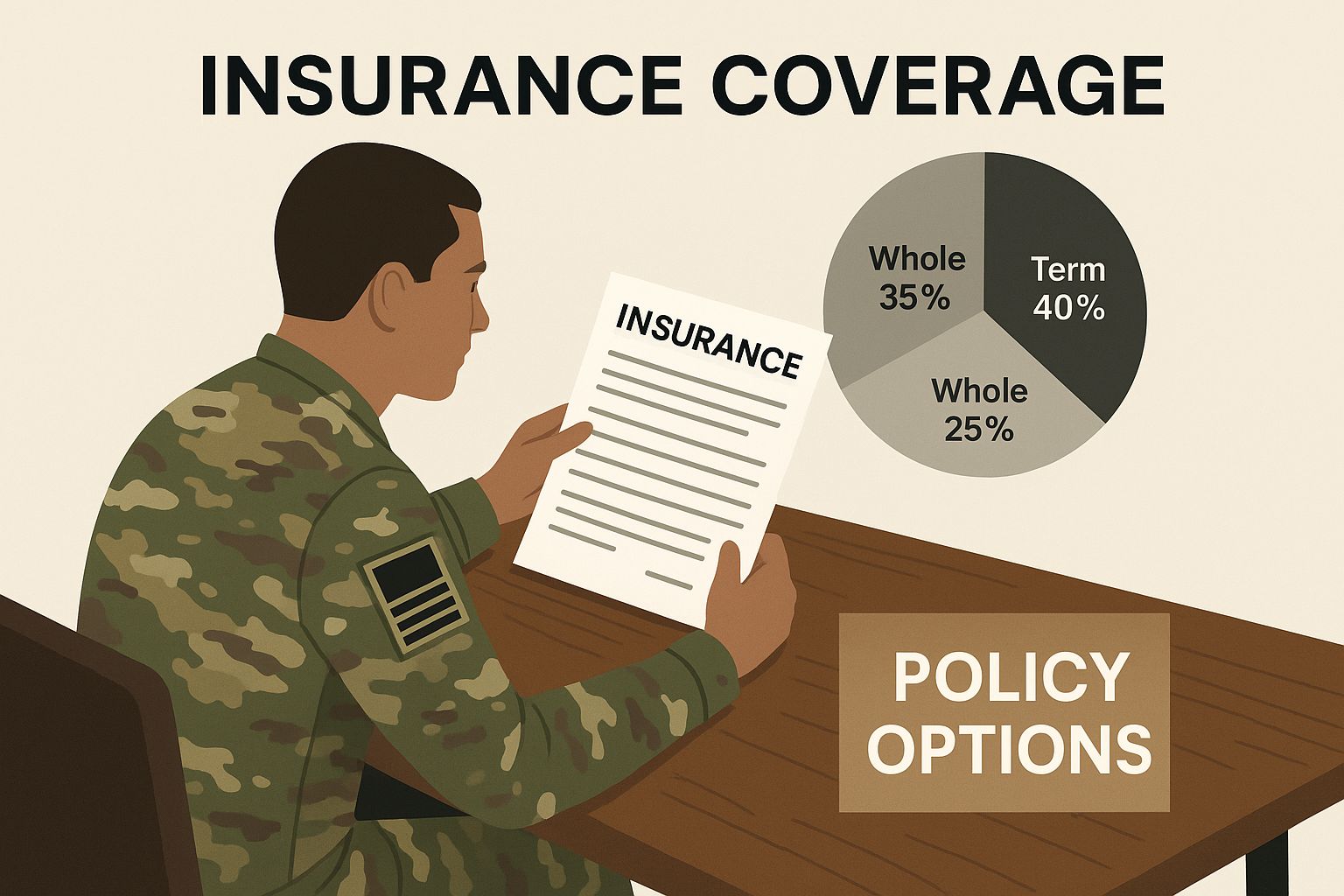
It is vital to look closely at what each policy does to ensure it aligns with your financial goals. A well-informed choice now means your family receives the support they actually need, right when they need it most.
Level Term Versus Decreasing Term Assurance
The two policies you will encounter most often are Level Term and Decreasing Term. They might sound similar, but they are designed for different purposes.
Level Term Assurance is straightforward. You choose a payout amount (the 'sum assured') and a policy duration (the 'term'). If you pass away during that time, your family receives the full, fixed lump sum. The payout amount never changes.
- Example: A new parent might take out a £250,000 level term policy over 25 years. It provides a reliable safety net to cover everything from childcare and school fees to daily bills, ensuring their children are looked after until they become financially independent.
Decreasing Term Assurance, on the other hand, is specifically designed to cover a large debt that reduces over time—most commonly a repayment mortgage. With this policy, the payout amount decreases each year, staying roughly in line with your outstanding mortgage balance. Because the potential payout gets smaller, these policies are usually than level term cover.
- Example: A service member buying their first home could take out a decreasing term policy to ensure their family can pay off the mortgage if the worst should happen. It is a cost-effective way to protect the family home.
To make the choice clearer, let's compare the key differences side-by-side.
Level Term vs Decreasing Term Life Insurance for Military Personnel
| Feature | Level Term Assurance | Decreasing Term Assurance |
|---|---|---|
| Payout Amount | Stays the same throughout the policy term. | Decreases over time, typically in line with a mortgage. |
| Main Purpose | Providing a fixed sum for family living costs, inheritance, or covering an interest-only mortgage. | Covering a repayment mortgage or other large, decreasing debt. |
| Premiums | Generally higher than decreasing term for the same initial cover amount. | Usually because the insurer's risk reduces over time. |
| Best For | Families needing a consistent financial safety net for long-term expenses like education and childcare. | Homeowners who want an affordable way to ensure their mortgage is paid off, protecting the family home. |
Ultimately, Level Term offers a stable, predictable payout, while Decreasing Term is a more targeted, budget-friendly tool for clearing specific debts.
Whole of Life and Valuable Add-Ons
While term policies only last for a set number of years, a Whole of Life policy does exactly what its name suggests. It guarantees a payout whenever you pass away, provided you have kept up with the premiums. They are more expensive but can be a suitable option for covering funeral costs or leaving a competitive inheritance.
You can also enhance your policy with useful add-ons:
- Critical Illness Cover: This pays out a tax-free lump sum if you are diagnosed with a serious illness specified in the policy, such as certain cancers, a heart attack, or a stroke. It provides a financial cushion to handle treatment costs or cover lost income while you focus on recovery.
- Terminal Illness Cover: This is often included as standard in most term policies. It allows you to claim your life insurance payout early if a doctor confirms you have a terminal illness with a life expectancy of less than 12 months. This can be a significant help for arranging end-of-life care and putting your finances in order.
Choosing the right military life insurance UK policy is about weighing these options against what your family truly needs. If you are unsure how much cover to get, it is worth consulting guides on calculating your life insurance needs.
How Your Military Role Shapes Your Policy
When you for life insurance as a member of the UK Armed Forces, insurers need a clear picture of what you do. This process, called underwriting, is how they determine the level of risk involved and calculate your premiums. It is not about penalising you for your service; it is about understanding the specifics of your job to build a policy that offers genuine protection.
An insurer will look beyond your cap badge and into the details of your day-to-day role. The answers you provide are vital. They not only shape the terms of your cover but also ensure your policy is solid if your family ever needs to make a claim.
The Key Factors in Your Risk Assessment
To set your policy terms correctly, underwriters will ask about several key areas of your military career. They need this information to price your premiums fairly and, crucially, to ensure the policy offers the worldwide cover you require.
The main factors they will consider include:
- Your Trade or Specialisation: There is a significant difference between a desk-based administrative role and an infantry soldier or a Royal Marines Commando. Your specific trade is a primary factor.
- Deployment History and Future Plans: Insurers will need to know about recent deployments and any upcoming operational tours to assess your potential exposure to higher-risk environments.
- Hazardous Duties: If you are involved in activities like parachuting, diving, or bomb disposal, you take on extra risk. It is essential to declare these duties. Standard insurers often cannot cover them, but specialist providers are equipped to handle these specific risks.
Being completely upfront during your application is non-negotiable. Full and honest disclosure ensures that if the worst should happen, there are no last-minute complications, and your policy pays out as it should—giving your family the financial security they need.
Why Honesty Really Is the Best Policy
The concept of risk assessment for life insurance is not new. The foundations of modern underwriting date back centuries, with the UK market expanding significantly in the 19th century. This long history has taught insurers one crucial lesson: accurate information is the bedrock of a valid policy. You can discover more insights about the history of UK life insurance to see how the industry has evolved.
Withholding information about your duties or future deployments might seem like a way to get a premium, but it could render your entire policy worthless. If an insurer discovers that key details were deliberately omitted, they have the right to void the policy under the rules set out by the Financial Conduct Authority (FCA).
This principle applies to any high-risk job. For instance, our guide on life insurance for firefighters shows how their specific on-the-job risks are assessed similarly. Specialist insurers are not trying to catch you out; they are simply gathering the facts needed to offer you a fair contract that you can truly depend on.
Navigating Health Conditions and Your Application

Your health, both physical and mental, is a major factor in any life insurance application. For service members, this can be a point of concern, especially considering the unique pressures and risks of the job.
It is absolutely vital to be upfront and honest about your entire medical history. This includes any service-related injuries, ongoing treatments, or diagnoses for conditions like Post-Traumatic Stress Disorder (PTSD), anxiety, or depression.
How Mental Health Affects Your Application
Insurers take mental health very seriously. Conditions like PTSD, depression, and anxiety are more prevalent among service personnel and naturally play a part in an insurer's risk assessment.
Full disclosure is non-negotiable. Hiding a diagnosis might seem tempting, but it could invalidate your policy, leaving your family with nothing.
While a mental health diagnosis might result in higher premiums or specific policy exclusions, it does not mean you will be automatically denied cover. Specialist insurers have experience in assessing these conditions fairly. They will simply require more information, such as:
- When you were diagnosed.
- The type and frequency of treatment you have received.
- How well your condition is currently managed.
- Whether you have ever been hospitalised or required significant time off work.
It can be helpful to understand how different pre-existing conditions are viewed, from physical injuries to understanding health conditions like ADHD and their classifications.
Understanding the Suicide Clause
Nearly every life insurance policy in the UK, including those for military personnel, contains a ‘suicide clause’. This is a standard term which typically states the policy will not pay out if the policyholder dies by suicide within the first 12 to 24 months after the policy begins.
It is important to know this clause is not intended to penalise individuals with mental health conditions. It is a safeguard for the insurer to prevent fraud—specifically, to stop someone from taking out a policy with the immediate intention of ending their life. This protects the insurer and, by extension, all other policyholders.
Once this initial period has passed, the policy will generally provide full cover according to its terms. If you are concerned about how your medical history might affect an application, you can learn more about ing for life insurance with medical conditions. Being proactive and well-informed is your best strategy for securing the right protection for your family.
Finding the Right Military Life Insurance Quote
Ensuring your family is financially secure is one of the most important responsibilities you have. To find the right military life insurance UK quote, you need to bring together all the key decisions we have discussed.
First, clarify your objective. Is the main goal to cover a repayment mortgage, for which a decreasing term policy would be suitable? Or are you looking to leave a competitive, fixed lump sum to secure your family's future, making level term cover the better choice? It’s crucial to calculate the amount of cover you need to see your family through.
Next, consider any add-ons that could make a real difference, such as Critical Illness Cover. This can provide a vital financial safety net if you were to become seriously unwell. Once you have clarified these points, you are in a great position to start comparing policies and quotes.
The Value of a Specialist Broker
While you can approach insurers directly, there is a significant advantage to working with a specialist broker who understands the military market. They are familiar with this niche and know which insurers, such as Aviva, Legal & General, and Royal London, are most favourable for Armed Forces personnel.
A specialist knows how to navigate the underwriting process for military roles, ensuring your application is presented in the best possible light. They know which providers are less likely to exclusions to your policy because of your specific trade or upcoming deployments. This expert guidance can save you time and potentially lead to a better policy with more competitive premiums.
A broker acts as your advocate, comparing a range of policies from different UK insurers to find the one that truly fits the unique risks and demands of your service. That kind of specialised support is invaluable.
For a deeper insight into how an expert can help, check out our guide on the top 10 reasons to use a life insurance broker.
Protecting your family’s future is simply too important to leave to chance. Take the next step today and get a personalised, no-obligation quote from our team of specialists.
Frequently Asked Questions (FAQ)
Here are clear, direct answers to some of the most common questions we receive from serving personnel.
Will my policy cover me on deployment?
Yes, a dedicated military life insurance policy is designed to provide worldwide cover. This means you are protected whether you are at home, on exercise, or deployed to an operational zone where a standard civilian policy would likely be invalid. The key is to be completely honest when you , providing full details about your role and potential deployments.
What happens to my cover when I leave the forces?
Your personal life insurance policy belongs to you, not the military. When you leave the service, the policy goes with you. You may even find your premiums decrease. Once you are in a civilian job, your risk level will be reassessed. It is important to inform your insurer as soon as your circumstances change, as a premium review could save you money.
Is military life insurance the same as the Armed Forces Compensation Scheme (AFCS)?
No, they are two different things. The AFCS provides compensation if you are injured, fall ill, or die as a direct result of your service. Personal life insurance provides a competitive tax-free lump sum to your loved ones if you pass away during the policy term, covering death from most causes. It is designed to help with major financial commitments like paying off a mortgage or covering family living costs.
Will I need to have a medical examination?
Not always. Whether a medical exam is required depends on the amount of cover you are ing for, your age, and the information you provide about your medical history. Many applicants are approved based on their application form alone. If you are ing for a very large sum assured or have a significant pre-existing medical condition, the insurer might request a report from your GP to get a complete picture of your health.
Figuring out military life insurance can feel like just another piece of admin, but getting it right is a mission you can't afford to fail. Here at Discount Life Cover, our specialists are on hand to help you find the right protection for your family, at an affordable price.
Get your free, no-obligation quote today and make sure your loved ones are looked after.
This article is for information purposes only and does not constitute financial advice. Discount Life Cover is not providing personalised recommendations. Insurance policies vary depending on individual circumstances. For advice tailored to your situation, please speak with a qualified financial adviser or request a personalised quote.
Leave a Reply