A Paramedic’s Guide to Life Insurance in the UK
Published
It’s a common worry among paramedics: does my job automatically mean I’ll pay a fortune for life insurance? The good news is, for most UK paramedics, this is a complete myth. Insurers are usually far more interested in your personal health and lifestyle than your profession, which means affordable paramedic life insurance is absolutely within reach.
Why Your Job Might Not Bump Up Your Premiums
Many paramedics assume their job instantly puts them in a high-risk box for life insurance, sending costs through the roof. While the job is undeniably demanding and comes with its own set of pressures, most UK insurers take a surprisingly balanced view of the risks involved. They understand the day-to-day reality of the role and, in the vast majority of cases, won't add higher premiums just because you're a paramedic.
Instead of focusing on your occupation, insurers build a complete picture of you as a person. Factors like your age, your general health, whether you smoke, and your family’s medical history typically carry far more weight than your job title. This means a fit, non-smoking paramedic is often seen as a lower risk than someone in an office job who has underlying health conditions.
This infographic breaks down what insurers really look at when calculating your premium.
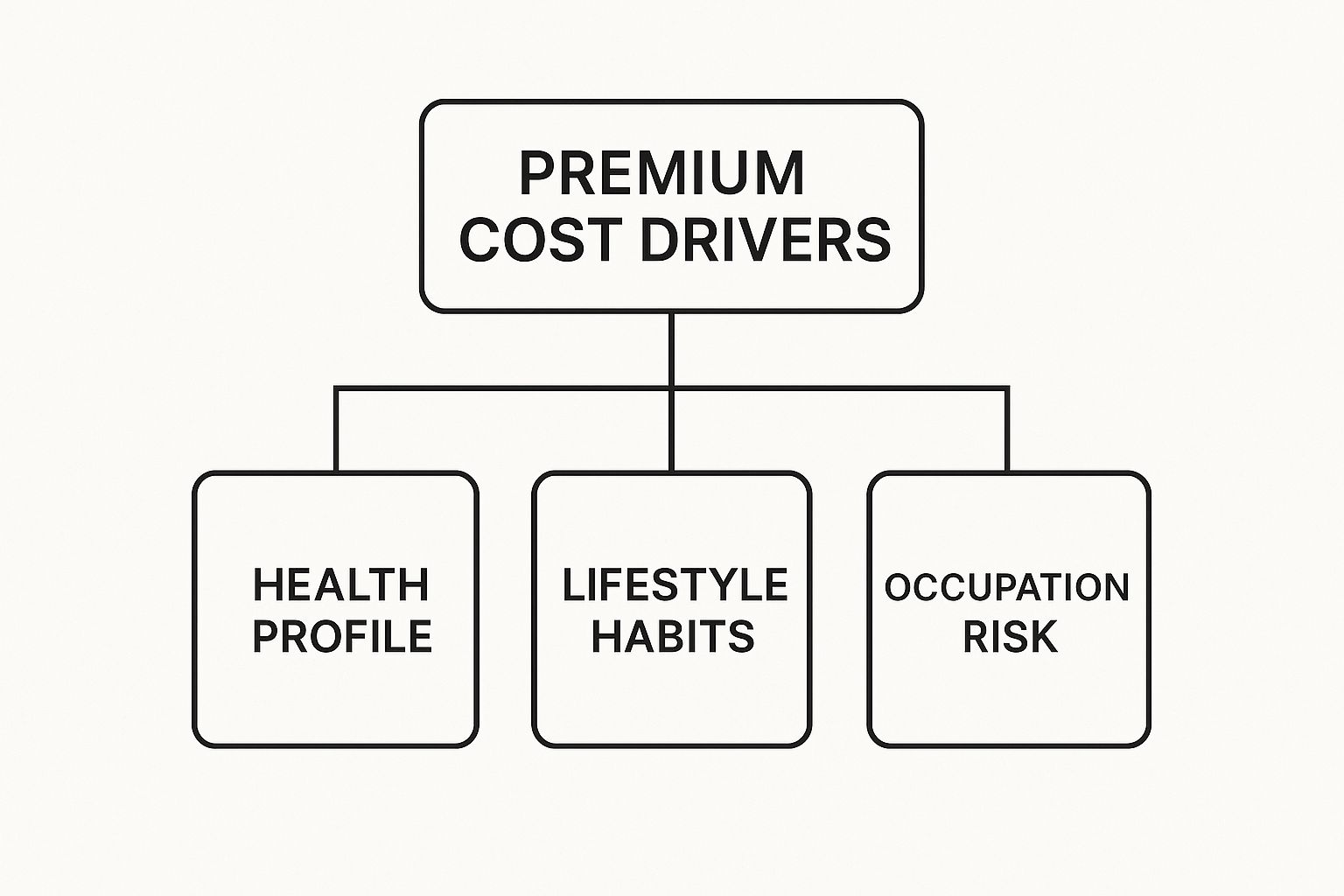
As you can see, your personal health profile and lifestyle choices are the most significant factors, often completely outweighing the perceived occupational risk for a standard paramedic role.
How Insurers View Paramedic Roles
It's true that some highly specialised roles, like being part of a Hazardous Area Response Team (HART), might be viewed differently. These duties can sometimes lead to what’s called a premium "loading" (an increase in price) or special terms on your policy. For the majority of frontline NHS paramedics, though, this simply isn't a factor.
Misconceptions about cost have persisted for years, but the reality is more nuanced. Insurers don't base decisions on perceptions of a job's danger; their decisions are based on statistics and actual claims history. For most of the UK’s major providers, the data does not support charging paramedics extra. This data-driven approach, regulated by the Financial Conduct Authority (FCA), ensures your policy is priced on your unique circumstances, not on outdated ideas about your career.
To give you a clearer picture, here’s a quick summary of the key factors paramedics should keep in mind.
Key Life Insurance Considerations for Paramedics
| Consideration | Why It Matters for Paramedics | Recommendation |
|---|---|---|
| Your Personal Health | This is the single biggest factor. Insurers prioritise your health over your job title. | Maintain a healthy lifestyle, stay on top of medical check-ups, and be completely honest on your application. |
| Specialist Roles (e.g., HART) | Duties involving hazardous materials or extreme environments can sometimes attract higher premiums. | Disclose the full nature of your role. A specialist broker can find insurers who understand these risks fairly. |
| "Death in Service" Benefits | Many NHS paramedics have this, but it may not be enough to cover a mortgage or family living costs. | Review your existing cover to see if you need a top-up policy for comprehensive protection. |
| Mental Health Disclosures | The high-stress nature of the job means mental health support is crucial. Insurers are getting much better at assessing this. | Be open about any history of stress, anxiety, or PTSD. A good adviser will know which insurers are most sympathetic. |
| Income Protection | If you're injured or unwell and can't work, life insurance doesn't help. This is a separate, vital cover. | Strongly consider adding income protection to safeguard your salary if you’re off work long-term. |
Ultimately, insurers look at the whole person. While your job is part of the story, it’s rarely the main character. For more detail on how different occupations are assessed, our guide to high-risk life insurance offers a deeper dive into the specifics.
Choosing the Right Policy to Protect Your Family

When it comes to paramedic life insurance, there's no such thing as a one-size-fits-all solution. The right policy for you will always depend on your personal circumstances. Do you have a mortgage? Young children depending on you? Or are you getting closer to retirement?
The first step to making a confident choice is understanding the main types of cover available in the UK.
Think of life insurance policies like the different tools in your response bag. You wouldn't use the same kit for every call-out, and the same logic applies here. You'll mostly come across three common options: Level Term, Decreasing Term, and Whole of Life insurance.
Each of these is designed for a different purpose, and knowing the difference is key to matching your cover to your financial goals. Let's break down how they work.
Level Term and Decreasing Term Explained
Level Term Insurance is perhaps the most straightforward. You choose a cash lump sum and a policy length (the 'term'). If you pass away during that term, your family receives that exact fixed amount. It's ideal for providing a stable financial cushion to cover everyday living costs, childcare, and future education fees, ensuring their lifestyle doesn't have to change.
Decreasing Term Insurance, on the other hand, is designed for one main job: to cover a large repayment loan, like a mortgage. The payout amount reduces over the life of the policy, roughly in line with your outstanding mortgage balance. Because the potential payout for the insurer shrinks over time, these policies are usually than level term cover.
Example: A paramedic with young children might choose Level Term insurance to ensure there's enough money to cover childcare and university fees if they were no longer around. In contrast, a homeowner might choose Decreasing Term cover purely to ensure their mortgage is paid off, protecting the family home.
Choosing between them comes down to what you're trying to achieve. Is your main priority leaving a specific lump sum for your children's future, or is it making sure the house is paid off, no matter what?
Figuring out the right amount of cover can feel a bit daunting, but our guide on calculating how much life insurance you need is a great place to start.
Other Policies to Consider
Beyond term insurance, you have a couple of other options. Whole of Life insurance does exactly what it says—it covers you for your entire life and guarantees a payout whenever you die. Because a claim is a certainty, these policies are much more expensive and are often used for specific purposes like inheritance tax planning.
For paramedics over 50, 'Over 50s' plans are another route. They offer competitive acceptance without any medical questions. While the payout is usually smaller (often capped at around £20,000), they're a simple way to cover funeral costs or leave a small gift behind.
How Your Paramedic Role Affects Your Application
When you for life insurance, you’ll find the questions about your job go a little deeper than simply asking for your title. Insurers want to build a clear picture of your day-to-day reality, which helps them accurately calculate the level of risk involved.
This isn’t about trying to catch you out or finding reasons to charge you more. It's a standard part of the underwriting process, designed to understand the real nature of your duties. Being completely honest here isn't just a good idea—it's vital for your policy to be valid.
If you withhold information or are not truthful on your application, it could give the insurer grounds to refuse a claim in the future. That would defeat the whole purpose of having cover in the first place.
The Questions Insurers Will Ask
You can expect insurers to ask about the specifics of what you actually do. They're trying to differentiate between a standard frontline paramedic and someone whose role involves more hazardous responsibilities.
Some common questions might include:
- What are your primary duties? This helps them see if you’re patient-facing, in a management position, or involved in training.
- Do you work for the NHS or a private service? This provides context about your working environment and the protocols you follow.
- Are you a member of a specialist unit? Being part of a Hazardous Area Response Team (HART) or a similar high-risk team will be a key point of interest.
- Do you work at heights or in confined spaces? These factors can sometimes influence an insurer's final decision.
For the vast majority of NHS paramedics, your answers will place you firmly in a standard risk category. This means you’re very unlikely to see your premiums increased just because of your profession. The questions are simply the insurer’s way of confirming this.
And while many employers offer a ‘death in service’ benefit, it’s worth learning about what group life insurance is to understand how these workplace schemes differ from a personal policy you own.
An insurer's goal is to accurately price a policy based on individual risk. By asking detailed questions, they ensure that a paramedic with standard duties isn't unfairly penalised for the higher risks associated with a specialist role they don't perform.
Ultimately, this detailed application process is a positive thing. It ensures your premium is a fair reflection of your personal circumstances, not just a broad assumption about your career. A transparent application leads to a reliable policy when it matters most.
Building a Financial Safety Net Beyond Life insurance
While paramedic life insurance provides a vital lump sum for your loved ones if the worst happens, true financial resilience often means looking at the bigger picture. A serious illness or injury that keeps you off the job could cause huge financial strain long before a life policy would ever pay out.
This is where other types of protection come into play. Think of them as working alongside your life insurance to create a much stronger shield against whatever life throws at you. For paramedics, two of the most important policies to consider are Critical Illness Cover and Income Protection. Both are designed to protect you and your family’s finances while you are still alive.
Critical Illness Cover Explained
Critical Illness Cover pays you a one-off, tax-free lump sum if you're diagnosed with a specific serious illness listed in your policy. The conditions covered vary between insurers like Aviva, Legal & General, and Zurich, but they almost always include major health events like a heart attack, stroke, or certain types of cancer.
For a paramedic, this kind of payout could be a game-changer. Imagine getting a diagnosis that means you have to step away from your demanding frontline role. That lump sum could be used to:
- Clear your mortgage, removing your biggest monthly outgoing.
- Adapt your home if you have new mobility needs.
- Pay for private medical treatment to help speed up your recovery.
- Fund a less stressful lifestyle while you focus on getting better.
The payout gives you financial breathing room when your health must be the priority, preventing a medical crisis from becoming a financial one.
How Income Protection Safeguards Your Salary
Income Protection works differently. Instead of one large lump sum, it pays out a regular, tax-free monthly income if you can't work because of illness or injury. This can replace a significant portion of your lost earnings, typically up to 60-70% of your gross salary, helping you keep on top of bills, mortgage payments, and everyday living costs.
Picture an on-the-job injury that leads to a long-term recovery period. While NHS sick pay offers initial support, it won't last forever. Income Protection is designed to start when your sick pay runs out, and it can continue paying you until you’re well enough to return to work, or until the policy term ends.
The need for this kind of safety net is backed up by some startling projections. It's estimated that by 2025, over 43% of working Britons will be diagnosed with a critical illness or face a long-term disability that stops them from working for at least six months before they reach state pension age. This highlights the real-world risk of financial disruption from unexpected health issues.
These policies are key building blocks for a robust financial plan. For a comprehensive overview of various borrowing options that can support your financial goals, you might find this ultimate guide to personal loans useful.
What Really Determines the Cost of Your Premiums?

It’s a common assumption that being a paramedic is the biggest factor that will increase the cost of your life insurance. The truth is, insurers are far more interested in you as an individual. Your job is just one piece of a much bigger puzzle.
When an insurer calculates your monthly premium, they are assessing risk. They look at several key parts of your life to get a complete picture of your health and lifestyle. It’s these elements, not your profession, that truly set the price you'll pay. Knowing what they are puts you back in control.
The most important factors are almost always the same for everyone, whether you’re a paramedic or a programmer. Let's break down exactly what insurers focus on when they put your quote together.
The Core Factors That Drive Your Premium
Your personal profile is what really matters. Insurers will focus on four main areas to determine how much your life cover will cost.
- Your Age: This is a major factor. The younger you are when you take out a policy, the your premiums will be. Statistically, you're less likely to fall ill, meaning you're a lower risk.
- Health and Medical History: Insurers need to know about your current health, your weight, any pre-existing conditions like diabetes or high blood pressure, and even your family’s medical history. Honesty is always the best policy here.
- Lifestyle Choices: Your habits play a massive role. Being a smoker or a heavy drinker will significantly increase your premiums because of the well-documented health risks involved.
- Hobbies and Activities: While your day job is seen as relatively low-risk by insurers, what you do in your spare time can sometimes have an impact. If you enjoy hazardous hobbies like rock climbing or motorsports, your premiums might be slightly higher.
The key takeaway is simple: a healthy, non-smoking paramedic in their 30s will almost always get a policy than an older, smoking office worker with a history of health problems. It’s your personal profile that truly counts.
A Real-World Cost Comparison
To see just how much these factors can affect your monthly payments, it helps to look at some real-world examples. The difference in cost can be significant, which highlights the financial benefit of arranging cover sooner rather than later.
The table below gives a clear idea of how personal circumstances affect cost. These are estimated monthly premiums for a £200,000 Level Term policy over 25 years.
Example Monthly Premiums for Paramedics
| Applicant Profile | Estimated Monthly Premium |
|---|---|
| 30-year-old paramedic, non-smoker, in good health | £8 – £12 |
| 30-year-old paramedic, smoker, in good health | £15 – £20 |
| 45-year-old paramedic, non-smoker, in good health | £20 – £28 |
| 45-year-old paramedic, smoker, with minor health issues | £45 – £60+ |
Please note: These figures are for illustrative purposes only. Your actual quote will depend on your unique circumstances.
As you can see, your age and whether you smoke have a much bigger impact on the premium than the job title ‘paramedic’. Securing a policy when you are young and healthy is the most effective way to lock in a low price for the entire duration of the policy.
Securing the Best Life Insurance Quote
Finding the right life insurance policy doesn't have to be a complex process. With a clear plan, you can lock in the best cover at a competitive price, giving you and your family lasting peace of mind. The key is to approach it methodically.
The most effective starting point is often to work with a specialist broker. While you can go directly to insurers, a broker who understands the underwriting process for paramedics can be invaluable. They already know which insurers view the profession most favourably and can search the market on your behalf, saving you a great deal of time and, often, money.
Your Simple Path to Getting Covered
Getting a quote is surprisingly straightforward when you break it down. A little preparation makes the entire process smoother and faster.
- Gather Your Details: Before you start, have your personal information ready. This includes your medical history, your family’s medical background, details about your paramedic role (especially any specialist duties), and your lifestyle habits like smoking or drinking.
- Compare Your Options: A good broker will take this information and return with quotes from across the market. This lets you compare real offers that are specific to you, not just generic online estimates.
- Complete the Application: Once you’ve chosen a policy, you’ll fill out the full application form. It is absolutely vital to be 100% honest here. This ensures your policy is valid and will pay out if a claim is ever made.
A Crucial Final Step: Placing Your Policy in Trust
Once your policy is approved and in place, there’s one final but crucial action to consider: placing it in trust. This is a simple legal arrangement that essentially ring-fences the policy payout from your estate.
Writing your policy in trust means the money can be paid directly to your chosen beneficiaries without getting stuck in the lengthy probate process. Crucially, it also means the payout is typically exempt from inheritance tax, ensuring your family receives every penny you intended for them.
Taking these steps ensures the financial safety net you've worked hard to put in place works exactly as it should when your loved ones need it most. Protecting your family is the ultimate goal, and with the right approach, securing affordable paramedic life insurance is an achievable and empowering step.
Ready to find out just how affordable your cover could be? Start by exploring your options and getting a free, no-obligation life insurance quote today.
Frequently Asked Questions (FAQ)
We understand that when you're looking into something as important as life insurance, questions will arise. Here are some of the most common ones we hear from paramedics, with straightforward answers.
Do I have to tell the insurer I'm a paramedic?
Yes, absolutely. You must be completely upfront about your job. Trying to hide it or misrepresent your duties is what insurers call ‘non-disclosure’. If they discover this later, they could cancel your policy and refuse to pay a claim, which would leave your family with nothing. It is not worth the risk.
Are there paramedic-specific exclusions I should be aware of?
For most UK paramedics, the answer is a reassuring 'no'. Standard life insurance policies don't typically exclude claims related to you doing your job. Exclusions are more likely to if you have particularly dangerous hobbies, such as BASE jumping or competitive motorsport. Always read the policy documents carefully, but you can be confident that your day-to-day duties are almost always covered.
Is my NHS 'Death in Service' benefit enough on its own?
While the NHS death in service benefit is a valuable workplace perk, it's rarely enough to provide complete financial security for a family. The payout is usually around two times your annual salary. That might cover funeral costs and pay off some debts, but it is unlikely to cover a mortgage, children's university fees, and the everyday cost of living for years to come.
Think of your NHS benefit as a solid foundation. A personal life insurance policy is how you build the rest of the house, making sure every part of your family’s future is sheltered and secure.
A separate policy puts you in control. You decide how much cover is needed, how long it lasts, and you can tailor it perfectly to what your family will actually need if you're not around.
Ready to make sure your loved ones are properly protected? At Discount Life Cover, you can compare quotes from the UK's top insurers in just a few minutes. Find the right policy at the competitive, with no fuss.
Get Your Free, No-Obligation Quote Today
This article is for information purposes only and does not constitute financial advice. Discount Life Cover is not providing personalised recommendations. Insurance policies vary depending on individual circumstances. For advice tailored to your situation, please speak with a qualified financial adviser or request a personalised quote.