Your Guide to UK Pilot Life Insurance
Published

You might think that getting life insurance as a pilot is a complex, drawn-out affair. It’s a common misconception. In reality, securing comprehensive pilot life insurance here in the UK is not only achievable but a fairly standard process for insurers.
While aviation is naturally seen as a higher-risk occupation, UK insurance providers are more than familiar with the territory. They are well-equipped to offer robust cover, meaning you can protect your family's financial future just like any other professional.
How Does Pilot Life Insurance Work in the UK?

Navigating the world of life insurance can feel a bit overwhelming, especially when you are in a specialised field like aviation. But at its heart, the principle is exactly the same: it is a financial safety net for your loved ones if the worst should happen. The real difference is how insurers assess the specific risks that come with your career in the sky.
Insurers in the UK do not just lump all pilots into one high-risk category. Instead, they carry out a detailed evaluation, a process known as underwriting, to really get to grips with your unique situation. This is all about making sure your policy and your premiums are a fair reflection of your personal and professional life.
Key Factors Insurers Look At
When you , an insurer’s goal is to build a clear picture of your life, both on and off the runway. This means they will look at all the usual life insurance factors, but with a few extra aviation-specific details thrown into the mix.
Insurers will want to understand the specifics of your flying career. They will look at the type of aircraft you fly, how many hours you clock each year, and the nature of your routes. To give you a clearer idea, here is a quick rundown of what they typically assess.
Key Factors Insurers Assess for Pilot Life Insurance
| Factor | What Insurers Look For | Potential Impact on Policy |
|---|---|---|
| Role & Aircraft Type | Are you a commercial airline pilot, a private pilot, a flight instructor, or in a more specialised role like crop dusting? They will consider if you fly a commercial jet, helicopter, or single-engine plane. | Commercial pilots on standard routes often get standard rates. More specialised flying could lead to higher premiums. |
| Flying Habits & Routes | What are your annual flying hours? Are your routes domestic and stable, or do you fly internationally into regions with higher risk, like conflict zones? | More hours or flights to hazardous areas can increase the perceived risk, potentially affecting your premium. |
| Professional vs. Recreational | Is your flying purely for your job, or do you also fly recreationally as a hobby? | Recreational flying, especially in certain types of aircraft, may be viewed differently and require a separate assessment. |
| Health & Lifestyle | This covers the standard checks: your age, general health, family medical history, and lifestyle choices. | Factors like being a smoker can significantly increase premiums, regardless of your profession. |
As you can see, it is about building a complete profile.
For instance, a 35-year-old non-smoking pilot looking for £500,000 of level term cover over 25 years might find a premium around £24.61 per month. But if that same pilot were a smoker, the cost could jump to over £56.47 per month. It is a stark reminder of just how much lifestyle choices matter. You can read more about how pilot life insurance costs are calculated to see other examples.
Ultimately, being a pilot absolutely does not stop you from getting quality life insurance. The key is to be open and provide clear, detailed information about your career and health. This allows you to secure a policy that gives you and your family solid protection. The best approach is always to work with providers or brokers who really understand the ins and outs of the aviation industry to find the most suitable and affordable cover for you.
Why Flying Is a High-Risk Occupation for Insurers

When you for pilot life insurance, the provider’s first job is to get to grips with the specific risks of your profession. It is no secret that modern aviation is incredibly safe. Still, the potential for a catastrophic incident—however small that chance might be—means insurers have to classify flying as a higher-risk occupation. This is not a comment on your skill; it is a statistical reality that helps them calculate premiums fairly.
Put yourself in their shoes for a moment. An underwriter has to weigh up the risk for every single person who applies. An office worker’s risk is mostly about their health and lifestyle. For a pilot, there is an extra layer of occupational risk that has to be carefully measured.
This is not just a tick-box exercise. Insurers delve into the fine details of your flying activities. They do not just see the word "pilot"—they see a detailed profile that allows them to quantify the risk properly.
The Spectrum of Aviation Risk
In the eyes of an insurer, not all flying is created equal. A long-haul commercial pilot flying an Airbus A380 for a major airline is a completely different risk profile from a helicopter pilot on search and rescue missions. The whole point of the underwriting process is to tell these roles apart.
Insurers break down aviation risk into a few key areas. Knowing what they are will give you a head start on the kinds of questions you will be asked during your application.
An insurer’s main goal is to build a precise picture of your daily professional life. The more detailed and clear the information you provide, the more accurately they can assess your application, which often leads to more favourable terms.
The crucial risk factors boil down to the type of flying you do, the aircraft you operate, and where your routes take you. Each piece of the puzzle helps the insurer build a complete picture of your risk.
Distinguishing Between Pilot Roles
How you spend your time in the air is probably the single biggest factor. Insurers group pilots into categories to better understand the hazards they face.
- Commercial Airline Pilots: This group is generally seen as the competitive risk within the profession. You operate under strict regulations, fly some of the most technologically advanced aircraft on well-established routes, and have extensive training and support. Many pilots in this role can get life insurance at standard or near-standard rates.
- Corporate or Private Jet Pilots: This is another role that is viewed quite favourably, although the sheer variety of aircraft and destinations might lead to a few more questions.
- Helicopter Pilots: Here, the risks can vary wildly. An emergency medical services (EMS) pilot faces very different dangers compared to someone flying offshore to oil rigs or giving sightseeing tours.
- Specialised Roles: If your job involves crop dusting, aerial photography, flight instruction, or test piloting, you will likely face higher premiums. This is down to the unique risks of the job, like flying at low altitudes or operating experimental aircraft.
Aircraft Type and Flying Hours
Beyond your job title, the specifics of your aircraft and your experience are vital. An insurer will always want to know what you fly. Flying a multi-engine commercial jet is statistically safer than a single-engine propeller plane, and your premiums will reflect that difference.
Your total flying hours also play a massive part. More hours in the logbook usually signal competence and can lead to better terms. A pilot with fewer than 300 hours of flight time might face higher costs or even specific exclusions, compared to a veteran with thousands of hours under their belt.
Finally, your typical destinations matter. Flying domestic routes between major UK airports is considered lower risk than regularly flying into politically unstable regions or active conflict zones. By understanding how insurers analyse these factors, you can go into the application process feeling confident and ready to give them the details they need for the right cover.
Navigating the Pilot Underwriting Process
Applying for life insurance as a pilot is not as complicated as you might think. Yes, there are a few extra hoops to jump through, but the process, known as underwriting, is really just the insurer's way of getting to know you. They need to build a clear picture of your life, both in the cockpit and on the ground, to give you a fair and accurate quote.
It all starts with a standard application, but things quickly get more specific to your career. You will soon come across the 'Aviation Questionnaire', a key document that helps insurers understand the unique parts of your flying life.
This infographic breaks down the main stages you can expect on your underwriting journey.
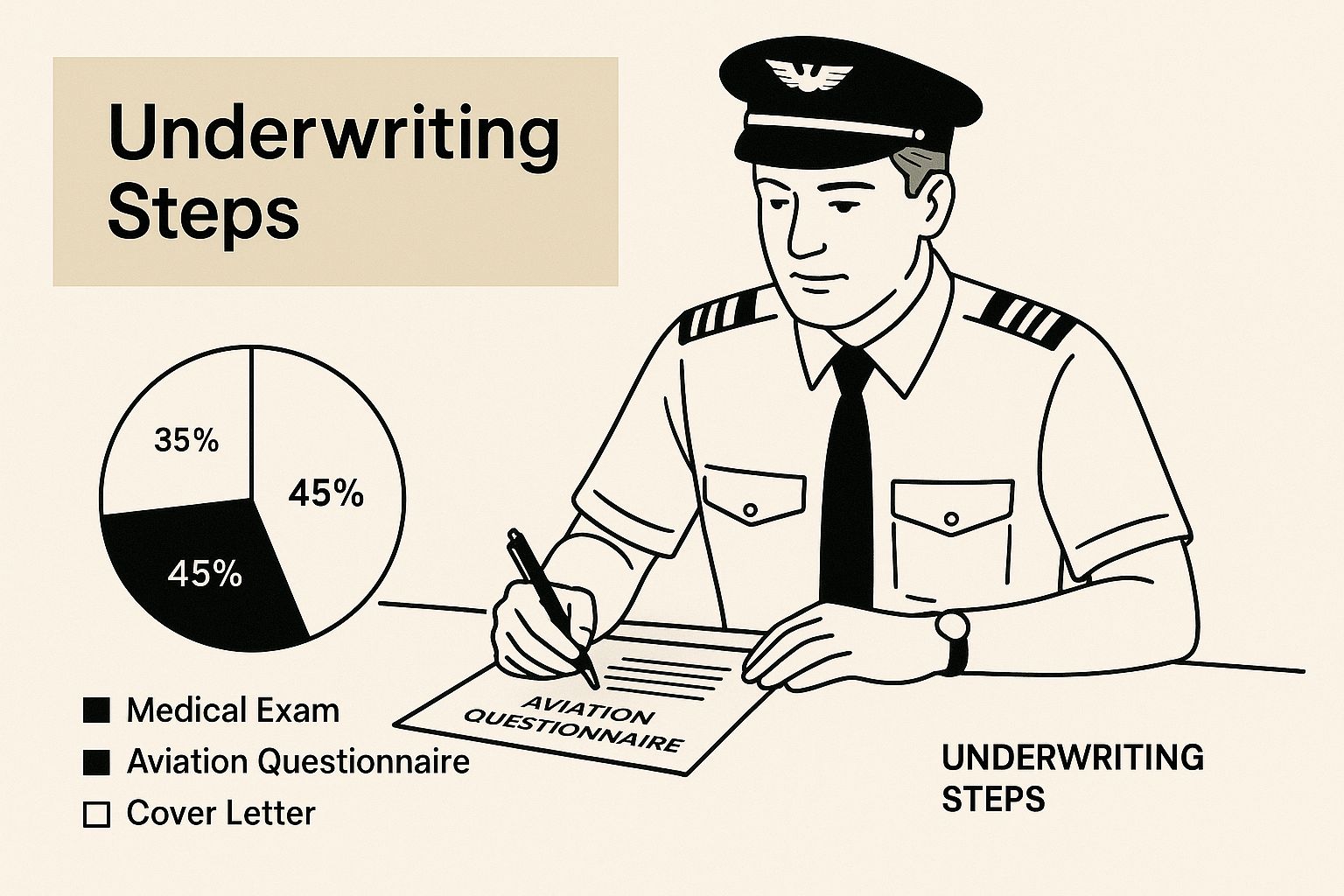
As you can see, it is a structured look at your professional flying habits and your personal health. Let's break it down.
Demystifying the Aviation Questionnaire
The Aviation Questionnaire sounds more intimidating than it is. It is just a set of focused questions designed to give the underwriter a complete view of your time in the air. Being honest and accurate here is absolutely crucial – it is the key to getting a policy that is valid when you need it most.
You will be asked about things like:
- Your Qualifications: Do you hold a Private Pilot Licence (PPL) or an Airline Transport Pilot Licence (ATPL)? Your licence level speaks volumes about your experience.
- Annual Flying Hours: How many hours do you log each year? More experience is often seen as a good thing.
- Type of Flying: Are you flying commercially for an airline, or is it purely for recreation?
- Aircraft Details: What are you flying? A multi-engine jet, a single-engine prop, or a helicopter?
- Geographical Routes: Do your typical flight paths take you into higher-risk areas, like conflict zones?
This information helps the insurer place you in the right risk category, making sure your premium is a fair reflection of your activities.
Think of the questionnaire as your co-pilot during the application. Providing clear, detailed answers helps the insurer navigate the risk assessment smoothly, often leading to a quicker and more favourable outcome.
The whole process is thorough. Insurers might ask for more medical evidence, like a report from your GP, especially if you are a bit older or ing for a large amount of cover. But do not let that put you off. The British Airline Pilots’ Association (BALPA) represents over 10,000 UK commercial pilots—that is more than 85% of the workforce—which shows the vast majority get the cover they need. For more on how UK pilots handle their insurance, you can explore data on pilot insurance trends.
The Role of Your Medical History
As a pilot, you are no stranger to rigorous medical exams to keep your licence. This actually gives you a big head start when ing for life insurance. Your regular medicals create a strong, documented history of good health, which is incredibly reassuring for an underwriter.
Of course, they will still look at your overall health profile, including any pre-existing conditions. It is vital to disclose everything. Conditions like diabetes or heart issues will be factored in, and while they might lead to higher premiums or specific exclusions, not mentioning them could invalidate your policy completely.
Lifestyle Choices and Their Impact
Finally, underwriters will look at your lifestyle choices, just as they do for everyone else. What you do outside of your aviation career plays a big part in working out your final premium.
Key things they will look at include:
- Smoking Status: Being a smoker or using nicotine products will significantly push up your premiums because of the health risks.
- Alcohol Consumption: They will want to know about your weekly alcohol intake.
- Hobbies: Do you have other high-risk hobbies? Things like scuba diving or mountaineering will also be factored into their assessment.
By understanding each step of the underwriting process, you can get all your information ready and go into your application with confidence, knowing exactly what is coming.
Choosing the Right Life Insurance Policy
Once you have got your head around how insurers see your job, the next big step is picking the right policy. There is no special "pilot life insurance" product in the UK. Instead, you have access to the same policies as everyone else, just with underwriting that is tailored to your unique role in the cockpit.
The right cover really comes down to what you are trying to protect. Are you looking to pay off the mortgage so your family always has a home? Do you need to replace your income so they can live comfortably? Or are you thinking about leaving a longer-term financial legacy?
Each of these goals has a type of policy that is a perfect fit. It might seem like a huge decision, but when you break down the main options, it all becomes much clearer.
Comparing Life Insurance Policies for Pilots
To help you get a clear picture of what is on offer, this table breaks down the most common types of life insurance policies available in the UK. Think of it as a quick reference guide to match your family's needs with the right kind of financial protection.
| Policy Type | How It Works | Best For… | Typical Use Case |
|---|---|---|---|
| Level Term | The payout amount stays the same for the entire policy term. | Providing a fixed lump sum for your family to cover non-mortgage debts, living costs, and future expenses. | A homeowner wanting to leave behind £500,000 to replace their income and cover their children's university fees. |
| Decreasing Term | The payout amount reduces over time, usually in line with a repayment mortgage. | Covering a specific large debt that is being paid off over time, making it a very cost-effective option. | Ensuring the family home is completely paid off if you were to pass away before the mortgage is cleared. |
| Family Income Benefit | Instead of a lump sum, it pays out a regular, tax-free income until the policy term ends. | Replacing your monthly salary to help your family manage their day-to-day budget without financial stress. | A parent earning £8,000 a month wants their family to receive £4,000 a month to cover bills and school fees. |
| Whole of Life | The policy runs for your entire life and guarantees a payout whenever you pass away. | Estate planning, covering inheritance tax bills, or leaving a competitive financial gift to loved ones. | An over-50s person leaving a definite sum for funeral costs or to ensure children inherit a specific amount of money. |
Each of these policies serves a different purpose. Your choice will ultimately depend on your personal circumstances, your budget, and what financial peace of mind looks like for you and your family.
Level Term vs Decreasing Term Insurance
The two most common policies you will come across are Level Term and Decreasing Term. They both run for a set number of years (the 'term'), but how they pay out is quite different.
Think of Decreasing Term insurance as the perfect co-pilot for your mortgage. The amount of cover is specifically designed to shrink over time, closely tracking the outstanding balance on a repayment mortgage. This makes it a really smart, cost-effective way to make sure the house is safe and sound if you are not around.
Level Term insurance, on the other hand, is all about providing a fixed, stable safety net. The payout amount is locked in and stays the same whether a claim is made in year one or year twenty. This makes it brilliant for covering everything beyond the mortgage—things like daily living expenses, childcare, and future university fees.
The big question to ask yourself is: what is my main goal? Is it to wipe out a specific debt like the mortgage, or is it to provide a broader financial cushion for my family’s future?
Getting this bit right is the first step to building a solid protection plan. For a deeper dive, our guide on how to choose life insurance can give you even more clarity.
Family Income Benefit: A Different Approach
If the idea of your family receiving one massive lump sum feels a bit daunting, Family Income Benefit is a fantastic alternative. Instead of a single payout, this policy provides a regular, tax-free income every month or year for the rest of the policy's term.
This can be a much more manageable way to replace your salary. It helps your family handle ongoing expenses and budget effectively, without the pressure of having to suddenly manage a large investment. It provides a steady, predictable flow of cash right when they need it most.
Whole of Life Insurance
For pilots focused on leaving a competitive inheritance or making sure funeral costs are covered, Whole of Life insurance is another path. Just like the name says, it covers you for your entire life and pays out whenever you pass away, provided you have kept up with the payments.
Because a payout is competitive, these policies are naturally more expensive than term insurance. They serve a completely different purpose, leaning more towards legacy planning rather than protecting your family during your peak earning years.
Valuable Add-Ons for Extra Protection
Life insurance is there for your family if you are gone, but what about protecting your finances if something happens and you cannot fly? This is where add-ons become incredibly important, especially for pilots.
- Critical Illness Cover: You can add this to most life policies. It pays out a tax-free lump sum if you are diagnosed with a specific serious condition, like certain types of cancer, a heart attack, or a stroke. For a pilot, a serious diagnosis could easily mean losing your licence and your livelihood, making this cover a genuine lifeline.
- Income Protection: This is your financial back-up plan. It pays out a regular percentage of your income if you are unable to work due to any illness or injury. It is like a replacement salary, helping you pay the bills and keep things ticking over while you focus on recovery.
Financial advisers in the UK often suggest a lump sum cover of around 10 times your annual gross income. So, for a pilot earning £100,000, that could mean a £1 million policy. But remember, options like Family Income Benefit can also provide substantial support, tailored to what your family truly needs. You can learn more about how these policies work and explore different options for pilot loss of license insurance.
How Insurers Calculate Your Premiums
Trying to figure out exactly how an insurer lands on your final premium can feel a bit like decoding a complex flight plan. But really, it is a logical process that all boils down to risk. Your job as a pilot is obviously a big piece of the puzzle, but it is just one part of a much larger picture.
Insurers essentially blend the details of your professional life with all the standard personal factors to build a complete risk profile. This way, the premium you pay is a fair reflection of your time in the sky and your life on the ground. Let’s break down the key components that go into that final number.
Core Factors Influencing Your Premium
Long before your pilot’s licence comes into play, a few universal factors set the foundation for what you will pay for life insurance. These to everyone, regardless of what they do for a living.
- Age: It is simple, really. The younger you are when you take out a policy, the lower your premiums will be. That is because, statistically, younger people are less likely to have a claim made.
- Health and Medical History: Insurers will want a look at your personal medical history, and sometimes your family’s too, to get a clear picture of your health. Your regular, stringent pilot medicals can actually be a huge plus here.
- Smoking Status: This is one of the biggest drivers of cost, hands down. If you smoke or use nicotine products, you can expect to pay significantly more – often double what a non-smoker would pay for the exact same cover.
- Policy Details: The amount of cover you want (the sum assured) and the length of time you need it for (the policy term) directly affect the price. A bigger potential payout or a longer term will naturally mean higher premiums.
These elements create the baseline for your quote before any of your aviation-specific activities are even factored in. You can get a feel for how these variables impact costs in our in-depth guide to term life insurance rates.
The Aviation-Specific Calculation
Once that baseline is set, the underwriters will add what is known as the "aviation loading". This is an adjustment based purely on the risks associated with your specific flying habits. This is where your detailed answers on the Aviation Questionnaire become so important. They will look at your annual flying hours, the types of aircraft you fly, and whether your flying is commercial or purely recreational.
Think of it this way: a 30-year-old non-smoking commercial pilot flying stable international routes for a major airline is one of the competitive-risk profiles an insurer can see. On the other hand, a 45-year-old private pilot who smokes and flies a single-engine aircraft for fun will face much higher premiums. The combined health and occupational risks just stack up.
This tailored approach means you are not unfairly penalised for simply being a pilot. The UK life insurance market has seen healthy growth, with total premiums recently increasing by 7.1% in a single year. While you will not find a policy labelled "just for pilots," brokers confirm that aviators have access to the same range of policies as anyone else, with premiums simply adjusted to reflect the risk. You can discover more insights on the competitive UK insurance market and its statistics.
Actionable Tips for Lowering Your Premiums
While you cannot change your age, there are several practical steps you can take to potentially bring down the cost of your pilot life insurance.
- Maintain Excellent Health: Your commitment to passing those tough, regular medicals is your greatest advantage. If you continue to prioritise a healthy lifestyle, you will be in a strong position to get more favourable rates.
- Quit Smoking: If you are a smoker, quitting is the single most powerful thing you can do to slash your premiums. Insurers will often offer non-smoker rates once you have been completely nicotine-free for at least 12 months.
- Choose the Right Policy: Do not over-insure yourself. A decreasing term policy designed to cover a repayment mortgage, for example, will be than a level term policy for the same initial amount.
- Work with a Specialist: This is a big one. A broker who genuinely understands the aviation world is invaluable. They know which insurers are best for pilots and can help you present your risk profile in the most accurate and favourable light.
By getting to grips with these factors, you can take control of your application and lock in the most affordable protection for your family.
Frequently Asked Questions
Navigating life insurance when you are a pilot throws up some unique questions. Here are a few of the ones we hear most often, with some straight-talking answers.
Is life insurance more expensive for a private pilot than a commercial pilot?
Nine times out of ten, yes. Insurers tend to see private pilots as a higher risk. They operate under less stringent regulations and often fly less advanced, single-engine aircraft. Commercial pilots, on the other hand, have rigorous training, consistent flight hours, and sophisticated safety systems on their side, which all helps to bring premiums down.
But it is never black and white. The final cost always hinges on personal factors, like your total flying hours and the type of aircraft you fly. An experienced private pilot with a squeaky-clean record might still land some very competitive rates.
Will my life insurance policy pay out for an aviation accident?
In most situations, yes, it will. A standard UK life insurance policy is designed to pay out for an aviation-related death, but there is a crucial condition: you must have been completely honest about your job and any private flying when you applied. Your premium was calculated based on that declared risk.
It is absolutely vital to disclose everything. Holding back details could give the insurer grounds to invalidate your policy down the line. If there are any specific exclusions for seriously high-risk activities – think aerobatics or flying experimental aircraft – these would be made crystal clear before you ever sign on the dotted line.
What happens to my policy if I stop flying professionally?
If you hang up your headset and move into a lower-risk job on the ground, get in touch with your insurer straight away. It is often possible to have your policy reviewed, which could mean your monthly premiums come down.
There are no guarantees, as it all depends on the provider's terms and conditions, but it is always worth asking the question. On the flip side, if you take up flying as a hobby after getting a policy, you must let your insurer know. This changes your risk profile and is a material fact for your pilot life insurance policy. If you want to get a sense of how long these processes can take, you can find helpful information on general insurance claim timelines.
Ready to find the right protection for you and your family? The team at Discount Life Cover is here to help you navigate your options and get a personalised quote today. Get your free, no-obligation quote now.
This article is for information purposes only and does not constitute financial advice. Discount Life Cover is not providing personalised recommendations. Insurance policies vary depending on individual circumstances. For advice tailored to your situation, please speak with a qualified financial adviser or request a personalised quote.