A Parent’s Guide to Life Insurance in the UK
Published

The moment you become a parent, your world shifts on its axis. Suddenly, everything changes. Sorting out life insurance for a parent is one of those fundamental steps you take, creating a financial safety net that guarantees your children will be looked after, no matter what happens down the road. It’s a quiet promise that you’ll always provide for them, even if you’re not there to do it yourself.
Why Life Insurance Is A Parent's Essential Safety Net

Parenthood is an incredible journey, but it comes with a profound sense of responsibility. You've brought someone into the world who relies on you for absolutely everything, from their day-to-day needs to their biggest dreams. That's precisely why life insurance stops being an abstract financial product and becomes one of the most important decisions you'll ever make.
Think of it as a financial 'lifeboat' for your family. If the worst should happen, your policy pays out a tax-free lump sum. This payout can be a genuine lifeline for your partner and children, helping them keep their world as stable as possible during an unimaginably tough time.
Securing Your Family's Home And Future
For most families in the UK, the mortgage is the biggest financial weight on their shoulders. A life insurance payout can lift that weight completely, making sure your children can grow up in the family home without the fear and disruption of having to move. But its value goes way beyond just the bricks and mortar.
The money can also cover all sorts of other crucial things:
- Day-to-day living costs: From the weekly food shop and utility bills to new school shoes and bus fare.
- Childcare expenses: A huge and often unexpected cost if one parent is no longer around to share the load.
- Future education: Setting money aside for school trips, university tuition, or whatever path they choose.
- Replacing lost income: This gives your partner the breathing room to grieve and adapt, without the immediate financial pressure of having to work more.
More Than Just A Policy
Taking out life insurance is an act of love. It’s about foresight. It brings a unique peace of mind that comes from knowing you’ve put a solid plan in place to protect your family's future. After all, understanding the full scope of parental duties means looking beyond the immediate joys and challenges to secure that long-term stability.
A life insurance policy is, at its heart, a promise to your children. It’s you saying that their wellbeing is your absolute priority and that you’ve taken responsible steps to safeguard their future, even if you can't be in it.
This protection ensures a personal tragedy doesn't spiral into a financial catastrophe. It gives your children the chance to thrive, free from the extra burden of money worries. For any parent, it's a foundational piece of the puzzle.
The Real Financial Risks UK Families Are Facing
It’s completely normal to get wrapped up in the day-to-day joys of raising a family. But in doing so, it's all too easy to overlook the gaping financial hole your absence would suddenly leave behind. For countless UK families, this ‘protection gap’ is a real and present danger, even if it’s one we don’t like to think about.
The hard truth is, without a proper financial safety net, the emotional devastation of losing a parent can spiral into a full-blown financial crisis. Understanding what that gap actually looks like is the first step to closing it for good. It’s not just about a lost salary; it’s about the crushing pressure on the surviving partner to cover every bill, every debt, and every future dream, all on their own.
The UK's Parental Protection Gap
Just how big is this problem in the UK? The numbers are pretty stark. A shocking number of parents are going without cover, even though they know deep down what the consequences could be.
Recent research throws this into sharp focus. A staggering 39% of parents with children under 18 have no life insurance whatsoever. This is despite the fact that 90% of them admit they worry about how their family would cope financially if they died before their children were grown. This disconnect leaves millions of families horribly exposed. You can explore these findings on parental insurance in more detail here.
These aren't just faceless statistics. In the UK, around 26,900 parents of dependent children die each year. That means a family faces this reality every 20 minutes. It's a sobering thought, and it’s why getting life insurance for a parent shifts from being a ‘nice-to-have’ to an absolute necessity.
Making the Numbers Real
To really get your head around the risk, let's look at the actual financial burdens that would immediately fall onto your partner's shoulders. We’re not talking about small change here; these are major, long-term commitments that are incredibly tough to handle on a single income.
- The Mortgage: For most, the family home is the bedrock of stability. Yet, more than half (53%) of parents with a mortgage owe over £100,000. The average mortgage debt is a hefty £145,720—a figure that would be overwhelming to face alone.
- Childcare Costs: We all know childcare costs in the UK are sky-high. Losing a partner often means losing a caregiver, creating an instant need for paid childcare that can run into thousands of pounds a year.
- Day-to-Day Living: On top of the big debts, the everyday bills don't just stop. The food shopping, the gas and electricity, the petrol for the car—it all keeps coming. A life insurance payout ensures these basics are covered, giving your family crucial breathing space.
- Your Children's Future: From school trips and new uniforms to thinking about university, the costs of raising children only grow. A solid financial plan makes sure their opportunities aren't cut short by tragedy.
Picture this: your partner, already reeling from grief, is suddenly left to manage a £150,000 mortgage on their own, while also needing to find an extra £1,000 a month for childcare. This is the very scenario life insurance is designed to prevent.
Looking at these real-world figures helps reframe what life insurance is all about. It’s not just another monthly expense. It’s a shield that protects your family from these exact situations, making sure your partner isn’t forced into devastating decisions like selling the family home or working multiple jobs just to keep their head above water. By planning ahead, you give them a foundation of stability, allowing them to grieve and heal without the added trauma of a financial collapse.
Choosing the Right Type of Cover for Your Family
Stepping into the world of life insurance can feel a bit like learning a new language, but it really just boils down to a few key decisions. For parents, it isn't just about ticking a box; it's about choosing the right kind of financial shield to protect your family's future. The biggest choice you'll face is whether you need cover for a specific period or for the rest of your life.
This simple decision tree can help you see where you stand.
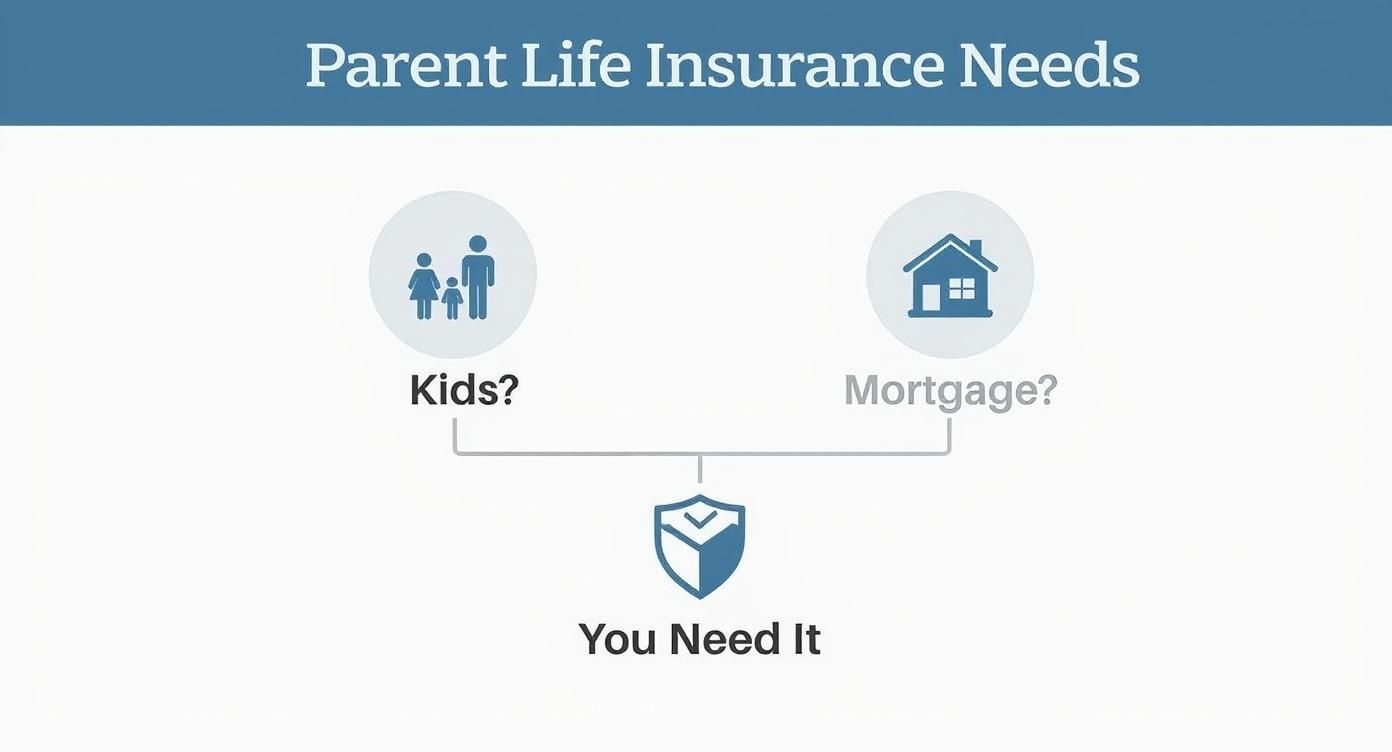
As the graphic lays out, if you have children or a mortgage, the need for a safety net becomes crystal clear. It cuts through the noise, showing that your biggest financial and family commitments are what really signal the need for cover.
To help you weigh up the most common options, here's a quick comparison of the policies parents usually consider.
Comparing Life Insurance Policies for Parents
A clear comparison of the most common life insurance policy types to help parents decide which best suits their family's needs, from mortgage protection to long-term financial security.
| Policy Type | Best For | Payout Structure | Typical Cost |
|---|---|---|---|
| Level Term | Covering ongoing expenses like childcare, education, and replacing lost income. | A fixed, lump-sum payout that stays the same throughout the policy term. | £ |
| Decreasing Term | Paying off a repayment mortgage or other large debts that reduce over time. | A payout that shrinks over the term, mirroring your outstanding mortgage balance. | £ |
| Whole of Life | Leaving a competitive inheritance, covering funeral costs, or settling an inheritance tax bill. | A competitive, fixed lump-sum payout whenever you pass away. | £££ |
| Joint Policy | Couples looking for a slightly more affordable option, often to cover a joint mortgage. | Pays out once, on the first death, after which the policy ends. | £-££ |
Each of these policies is designed with a different goal in mind. The right one for you really depends on what you're trying to protect—whether it's a specific debt or your family's entire financial future.
Term Life Insurance: The Popular Choice for Parents
Term life insurance is easily the most common type of life insurance for a parent here in the UK. It’s pretty simple: you pick a set amount of time (the ‘term’) for the policy to run, maybe 25 years to line up with your mortgage ending or until your children are on their own two feet. If you pass away during that time, your family gets the payout.
Because it’s so straightforward, it's generally the most affordable option out there, making it a brilliant choice for young families juggling all sorts of costs. Within term insurance, you'll come across two main flavours.
- Level Term Insurance: With this policy, the payout amount is set in stone for the entire term. If you take out £200,000 of cover for 25 years, your family gets that full £200,000 whether you pass away in year one or year 24. This is ideal for things that don’t get over time, like replacing your salary or funding your children's education.
- Decreasing Term Insurance: This one is specifically built to protect a repayment mortgage. The size of the potential payout gradually drops over the term, tracking your shrinking mortgage balance as you pay it off. Since the insurer's risk gets smaller over time, these policies are usually than level term cover.
Think of it like this: Level Term cover is a consistent financial shield, staying the same size to protect your family's overall lifestyle. Decreasing Term cover is a tailored solution that shrinks in perfect sync with your biggest debt—the mortgage.
Whole of Life Insurance: A Lifelong Guarantee
Unlike term insurance, a Whole of Life policy does exactly what it says on the tin—it covers you for your entire life. As long as you keep paying the premiums, it promises a competitive payout to your loved ones whenever you pass away.
That lifelong certainty comes at a price, though. Premiums for whole of life policies are significantly higher than for term insurance. People tend to use this type of cover for specific financial planning goals, like covering a future inheritance tax bill or leaving a competitive legacy for their children, rather than just covering temporary debts like a mortgage.
Joint vs Single Policies: What’s Best for Your Children?
If you’re part of a couple, you have one more big decision to make: do you get a single policy each, or one policy to cover you both?
A joint policy covers two people but only pays out once—usually on the first death. After that payout, the policy ends, leaving the surviving partner with no life cover at all. While this is often a bit than two single policies, it can leave a serious gap in your family's protection if the surviving parent were to pass away later on.
On the other hand, taking out two separate single policies offers much more comprehensive protection. If one parent dies, their policy pays out, and the surviving partner still has their own cover in place. If the unthinkable happened and both parents passed away, both policies would pay out, creating a much larger financial pot for the children's guardians to use. For that reason, two single policies are almost always the recommended route for parents who want true peace of mind.
How to Calculate the Right Amount of Life Cover
So, you’ve decided you need life cover. That’s a brilliant first step. But the next part—working out exactly how much cover you actually need—can feel like pulling a number out of thin air. It’s easily the most important piece of the puzzle, though.
Getting this right isn't about guesswork. A proper calculation means the payout will be enough to clear the mortgage, replace your income, and give your children a secure future. Let's break down how to arrive at a figure that gives you real peace of mind, without you overpaying for it.
Start with Your Major Liabilities
First things first, let's tally up all your outstanding debts. These are the immediate financial burdens your family would be left with if you weren't around. The goal is to make sure your life insurance can wipe that slate clean from day one.
Your checklist should include:
- Your Mortgage: For most of us, this is the biggest debt we have. Write down the full outstanding balance.
- Car Loans: Any money still owed on the family motor needs to go on the list.
- Credit Card Debt: Add up the balances on all your personal credit cards.
- Personal Loans: Don't forget any other significant loans you might have.
Clearing these debts lifts a massive weight off your partner’s shoulders, securing the family home and stopping a financial crisis before it even starts.
Factor in Future Family Expenses
Once the debts are dealt with, the next job is to think about the day-to-day costs of running your home and raising the children. You need to look ahead and figure out what your family will need until your youngest child can stand on their own two feet, maybe around age 21.
A good way to think about this is replacing your annual income for that period. Let's say you earn £40,000 a year and your youngest is just one year old. You’d want to cover that income for the next 20 years. Now, you don't necessarily need £800,000 (£40k x 20) in cover, because the lump sum can be invested, but it’s a solid starting point for your calculations.
A common rule of thumb is to aim for a cover amount that is roughly 10 times your annual salary. This provides a substantial lump sum that, if invested wisely, can generate an income to support your family for many years.
For a more precise figure, our guide on calculating how much life insurance you need dives into more detailed methods to help you land on the right number for your family.
Don't Overlook the Stay-at-Home Parent
One of the biggest—and most costly—mistakes families make is undervaluing what a stay-at-home parent brings to the table financially. They might not have a salary, but the work they do is incredibly valuable and would be eye-wateringly expensive to replace.
Just think about the cost of hiring people to cover all their roles:
- Childcare and nursery fees
- A cleaner for the house
- After-school clubs and taxiing the children around
- Cooking and managing the entire household
The financial impact of losing that unpaid labour is huge. Estimates suggest replacing the work a mother typically does could cost around £248 per week, while a father's contribution is valued at £169 weekly. Losing that support would put an enormous financial strain on the surviving parent, which is why life insurance for a stay-at-home parent is just as vital. Learn more about the value of parental insurance here.
By thoughtfully adding up your debts, future income needs, and the cost to replace a caregiver's duties, you can build a realistic picture of the cover your family truly needs. This makes sure your policy is a robust financial safety net, perfectly sized to protect the people you love most.
Adding Critical Illness and Income Protection Cover
A truly solid financial plan does more than just prepare for the absolute worst-case scenario. While life insurance is the essential foundation for any parent, a serious illness or injury can throw your family's finances into chaos just as easily. This is where adding extra layers of protection creates a comprehensive shield.
Two of the most powerful additions you can make are Critical Illness Cover and Income Protection. They’re designed to step in during those tough times when you're still here, but can't provide for your family in the same way. Think of it as creating a safety net that catches you, whatever life decides to throw your way.
What Is Critical Illness Cover?
Critical Illness Cover is designed to give you a significant financial boost right when you need it most. If you’re diagnosed with a specific, serious medical condition listed in your policy—things like some types of cancer, a heart attack, or a stroke—it pays out a one-off, tax-free lump sum.
This money is yours to use however you see fit, giving you immediate relief during an incredibly stressful time. Families often use the payout to:
- Cover medical costs: Pay for specialist treatments or care not available on the NHS.
- Adapt their home: Perhaps install a ramp or a downstairs bathroom to manage new mobility needs.
- Clear debts: Paying off a chunk of the mortgage or wiping out loans can massively reduce monthly stress.
- Replace lost income: It allows you or your partner to take time off work to focus on recovery without the financial worry.
Essentially, it gives you the breathing space to focus on your health, not your bank balance. You can learn more about how Critical Illness Cover works and the conditions it typically covers in our detailed guide.
Your Financial Backup Plan: Income Protection
While Critical Illness Cover provides a single payout for a specific condition, Income Protection acts as your financial backup plan if any illness or injury stops you from working. It’s not restricted to a list of critical conditions; it can cover you for a much wider range of situations, from a serious back injury to mental health struggles.
If you become unable to work, the policy pays you a regular, tax-free monthly income after a pre-agreed waiting period. This replacement salary keeps coming in until you can return to work, your policy term ends, or you retire—whichever happens first.
Think of Income Protection as a substitute for your monthly pay cheque. It ensures the mortgage still gets paid, the food shopping gets done, and the utility bills are covered, maintaining your family's lifestyle even when you can't earn.
Creating a 360-Degree Shield for Your Family
Bringing Life Insurance, Critical Illness Cover, and Income Protection together provides a powerful, multi-layered defence. This approach directly addresses the huge protection gap we see in the UK, where so many families are left financially vulnerable if the unexpected happens. Many UK adults have no life insurance at all, and a staggering number of parents with dependent children lack any kind of life cover. These numbers highlight just how urgent it is for families to get proper financial security in place.
Let's walk through a quick scenario: a parent has a heart attack.
- Their Critical Illness Cover pays out an immediate lump sum. They use it to clear their car loan and adapt their home for an easier recovery.
- After three months, their Income Protection kicks in, replacing their salary while they're off work getting better.
- All the while, their Life Insurance policy remains untouched, ready to protect their family's long-term future if the worst should happen later down the line.
This combined strategy ensures that an illness doesn't have to become a financial disaster for your family. By considering life insurance for a parent alongside these other crucial protections, you build a plan that truly prepares you for life's uncertainties.
How to Apply and Get the Best Possible Price

Starting your application for life insurance is a lot more straightforward than most people think. Really, insurers just need to build up a clear picture of you to work out your premium – that’s the regular payment you’ll make for your cover.
They’ll ask some simple questions that fall into four main areas. This isn’t about being nosy; it’s all about helping them understand the level of risk they’re taking on, which is what directly shapes the price you'll pay.
- Your Age and Health: It's no surprise that younger, healthier applicants usually get offered lower premiums.
- Your Lifestyle: Things like smoking or enjoying high-risk hobbies can push your costs up.
- Your Job: Insurers see a desk job as lower risk than, say, working on a construction site.
- Your Family Medical History: Some hereditary conditions might have an impact on your final premium.
It's absolutely vital to be completely upfront during your application. It might feel tempting to leave out a small detail to get a quote, but that's a huge risk. If an insurer discovers something was left out, it could invalidate your entire policy, leaving your family with nothing just when they need it most.
Simple Steps to Lower Your Premiums
While insurers set their prices based on risk, you actually have more control over the final cost than you might realise. There are a few practical things you can do to make your cover more affordable without having to cut back on protection.
The single most effective way to get a lower price is to look at your health. Quitting smoking is the biggest game-changer – premiums can drop significantly once you’ve been nicotine-free for at least 12 months. Even losing excess weight and cutting back on alcohol can lead to much more attractive quotes.
Comparing quotes is non-negotiable if you want the competitive. Premiums can vary wildly between insurers for the exact same level of cover, so you should never, ever accept the first offer you see.
How a Broker Simplifies the Process
This is where using a broker like DiscountLifeCover really makes a difference. Instead of you spending hours filling in form after form for different insurers, we do all the heavy lifting. We know the market inside-out and compare policies from a wide range of trusted UK providers to find the perfect fit for your family's needs and budget.
We can help you look at all the options and find the cheapest term life insurance deals out there, making sure you get brilliant value. Our goal is to make the whole process as smooth and simple as possible, guiding you towards an affordable policy that gives you genuine peace of mind.
Frequently Asked Questions
When you start digging into life insurance, it’s only natural for questions to pop up. To help clear things up, here are some straightforward answers to the questions we get asked most often by parents in the UK.
Is Life Insurance Really Necessary for a Stay-at-Home Parent?
Absolutely. It’s easy to overlook the sheer economic value a stay-at-home parent brings to a household. Think about childcare, managing the home, school runs, and cooking. If the worst were to happen, the surviving partner would suddenly face huge new bills for these services. A life insurance policy provides the funds to cover these new costs, preventing a financial crisis on top of an emotional one.
Should We Put Our Policies in a Trust?
This is a really smart move for most parents. Writing your policy in trust isn't as complicated as it sounds, but it has two massive benefits. First, it can help your payout avoid the 40% Inheritance Tax, meaning more of the money goes to your loved ones. Even more importantly, it helps the money bypass the long probate process, meaning your family can get the funds much faster—often in weeks instead of months.
What Happens to a Joint Policy if We Get Divorced?
This is a crucial bit of admin to sort out. If you have a joint policy, you’ll likely need to cancel it, and then each of you will need to arrange a new single policy. If you already have separate single policies, it’s much simpler. You just need to contact your insurer to update the beneficiary details to reflect your new circumstances. The key is to always review your cover after any major life event.
Can I Still Get Cover With a Pre-Existing Medical Condition?
Yes, in many cases, you can. The most important thing is to be completely honest and upfront about any health conditions when you . An insurer might charge a higher premium or add specific exclusions related to your condition, but it rarely means an outright 'no'. This is where specialist brokers really shine; they know which insurers are more likely to offer affordable cover for your specific situation.
Ready to take that next step and get some real peace of mind for your family's future? The team here at Discount Life Cover can help you compare quotes from the UK's leading insurers, making sure you find the right protection without paying over the odds.
Get your free, no-obligation quote today and tick one of the most important things off your to-do list.
Get Your Personalised Quote with Discount Life Cover
This article is for information purposes only and does not constitute financial advice. Discount Life Cover is not providing personalised recommendations. Insurance policies vary depending on individual circumstances. For advice tailored to your situation, please speak with a qualified financial adviser or request a personalised quote.