
When it comes down to it, any mortgage protection insurance comparison in the UK boils down to a single question: do you need a lump sum to clear the entire debt, or a regular income to keep up with the monthly payments? Think of the right policy as a financial safety net, one that ensures your family can stay in their home if your income suddenly stops because of death, illness, or injury. It’s the kind of protection your standard home insurance just doesn't offer.
Why Mortgage Protection is Your Financial Safety Net
Taking out a mortgage is a huge milestone. It secures your home, but it also saddles you with what will likely be the biggest debt of your life. While your standard buildings insurance protects the bricks and mortar, what’s protecting your ability to actually make the payments each month? That's exactly where mortgage protection steps in.
It isn't a single product, but rather a family of insurance policies designed to either pay off your mortgage entirely or cover the monthly payments if the unexpected happens. The whole point is to prevent your loved ones from facing a financial nightmare or, in the worst-case scenario, losing the family home.
It's surprising, then, how many homeowners skip this vital cover. Recent research revealed that over a third (36%) of UK mortgage holders have no life, income, or critical illness insurance. That leaves around 2.34 million households completely exposed. With nearly half (46%) admitting they’d struggle with mortgage payments after losing an income, the need for this safety net couldn't be clearer. You can read the full research on this financial protection gap to get a better sense of the risks.
The Core Types of Mortgage Cover
To properly compare mortgage protection insurance, you first need to get to grips with the main tools for the job. Each one serves a different purpose, and they can often be mixed and matched to build a really solid protection strategy for your family.
The three main players are:
- Term Life Insurance: Pays out a lump sum if you pass away during the policy's term. This cash is typically used to clear the outstanding mortgage balance in one go.
- Critical Illness Cover: Provides a tax-free lump sum if you're diagnosed with a specific serious illness. This gives you the freedom to pay off the mortgage, cover medical bills, or adapt your home.
- Income Protection: This acts more like a replacement salary. It pays out a portion of your monthly income if you can't work due to illness or injury, helping you keep on top of the mortgage and other essential bills.
In this guide, we'll break down exactly how each of these works, helping you figure out which combination is the right fit for you and your situation.
Comparing the Core Mortgage Protection Policies
When you start to compare mortgage protection insurance options, you’ll quickly realise they’re built to solve different problems. It's all about matching the policy's function to your specific financial situation and, crucially, the type of mortgage you have. Some policies are designed to pay a one-off lump sum to wipe the slate clean, while others provide a steady income to keep up with the monthly repayments.
Getting your head around these fundamental differences is the first step. It takes you from a vague sense of "needing cover" to a clear idea of which policy will actually provide the right support if you couldn't earn or were no longer around.
The infographic below gives a great summary of what mortgage protection is, why it matters, and how the different policies work to keep a roof over your family's head.
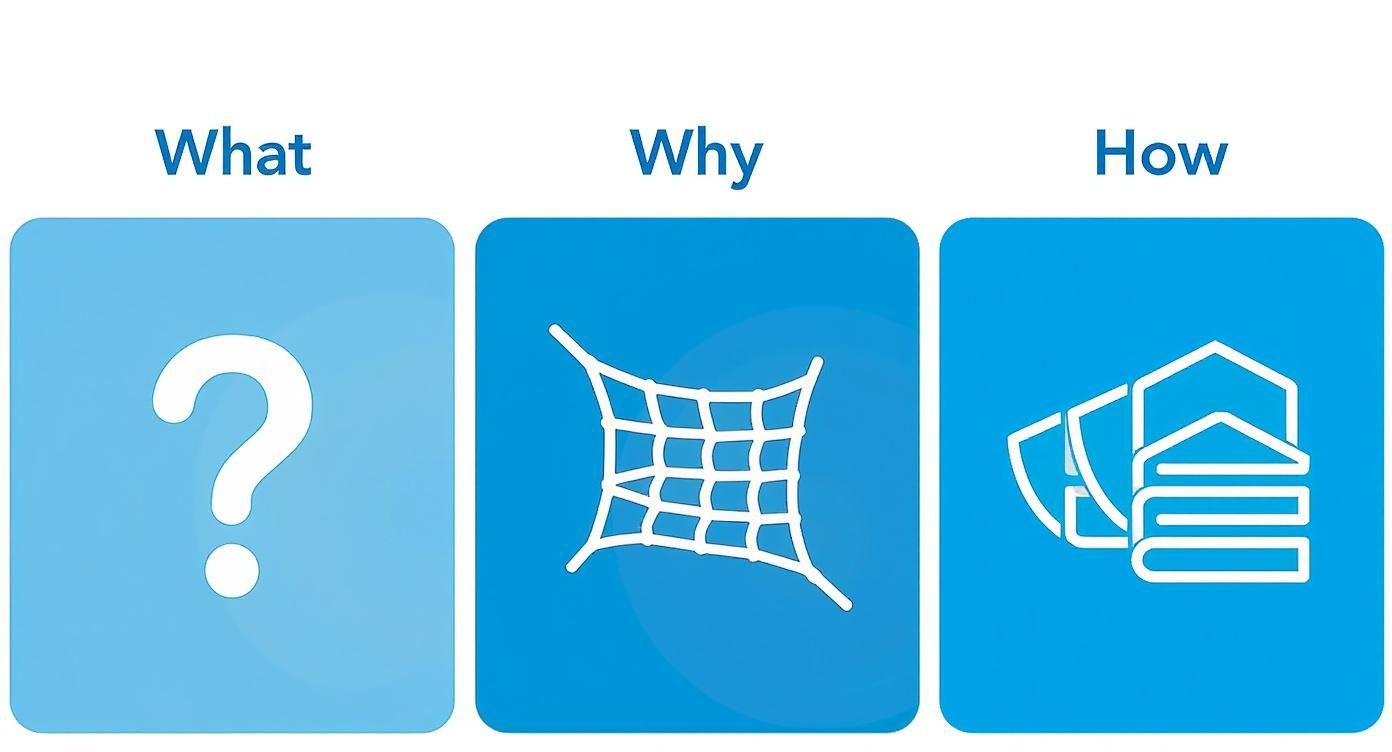
As you can see, the main goal is to create a financial safety net, making sure your mortgage gets paid no matter what life throws at you, whether that's a serious illness or passing away unexpectedly.
Decreasing Term Life Insurance
This is often the go-to, most affordable type of life insurance for homeowners. It’s specifically designed to work hand-in-hand with a standard repayment mortgage—the kind where the amount you owe the bank goes down over time.
A decreasing term policy is set up so the cover amount shrinks roughly in line with your outstanding mortgage balance. Because the potential payout gets smaller year on year, the premiums are typically much lower than other types of life cover. For a deeper dive, you can learn more about what decreasing term life insurance is and exactly how it works.
- Best For: First-time buyers and anyone on a tight budget with a repayment mortgage. It’s a cost-effective way to ensure the debt is cleared if the worst should happen.
Level Term Life Insurance
Unlike its decreasing cousin, level term life insurance provides a fixed lump sum payout no matter when a claim is made. Whether it’s in year one or year twenty of the policy, the amount paid out is exactly the same.
This makes it the perfect fit for interest-only mortgages, where the capital debt doesn’t reduce until the very end of the term. It's also a popular choice for families wanting to leave more than just a paid-off house, perhaps to cover funeral costs or future university fees.
- Best For: Homeowners with an interest-only mortgage or those who want to provide an extra financial cushion for their loved ones on top of clearing the home loan.
Critical Illness Cover
This policy is designed to pay out a tax-free lump sum if you're diagnosed with a specific, serious medical condition listed in the policy terms, such as certain types of cancer, a heart attack, or a stroke. Think of it as a financial lifeline during a period of massive health and emotional stress.
The money can be used for absolutely anything you need—from paying off the mortgage to funding private medical care or making your home more accessible. It’s vital to read the policy documents carefully, though, as the list of conditions covered can vary a lot between insurers like Aviva, Legal & General, and LV=.
- Best For: Anyone who wants financial protection from the massive impact of a serious illness, ensuring their mortgage and other big bills are sorted so they can focus entirely on getting better.
Income Protection
Instead of a single lump sum, income protection provides a regular, tax-free monthly income if you’re unable to work because of illness or an injury. In short, it steps in to replace your salary.
An Income Protection policy is all about long-term support. It can keep paying out until you're well enough to return to work, or right up until the end of the policy term, which is often set to match your retirement age.
- Best For: Absolutely anyone who relies on their monthly salary to pay the mortgage and keep the lights on. It’s especially crucial for the self-employed or those in jobs with minimal sick pay.
Before we move on, let's put these four core policies side-by-side. Seeing them in a table can really help clarify which one aligns best with your personal circumstances and priorities.
Mortgage Protection Policy At-a-Glance
| Policy Type | Primary Purpose | Payout Structure | How Cover Changes | Best For |
|---|---|---|---|---|
| Decreasing Term Life Insurance | Pay off a repayment mortgage upon death | Lump sum | Decreases over time | Repayment mortgages; budget-conscious buyers |
| Level Term Life Insurance | Pay off mortgage & provide extra funds | Fixed lump sum | Stays the same | Interest-only mortgages; leaving a legacy |
| Critical Illness Cover | Financial support after serious diagnosis | Lump sum | Stays the same | Protecting against illness-related costs |
| Income Protection | Replace lost salary due to illness/injury | Regular monthly income | Stays the same | Anyone reliant on their monthly salary |
This at-a-glance view should make it easier to see the distinct role each policy plays. The key is to think about what would cause the biggest financial strain for your family—losing your income, a sudden large debt, or the costs associated with a major illness—and choose the cover that directly addresses that risk.
Choosing the Right Life Insurance for Your Mortgage
When you start to compare mortgage protection insurance, the conversation nearly always lands on two main types of life cover: decreasing term and level term. At first glance, they might seem similar—both pay out if you pass away during the policy's term. But dig a little deeper, and you’ll find they’re built for completely different jobs, aligning with very different financial goals and family situations.
Getting your head around these differences is the key to picking a policy that actually delivers the security you're paying for.
Decreasing term insurance is the no-frills, cost-effective option designed for one specific task: clearing a standard repayment mortgage. Its whole purpose is to pay off what’s left on your home loan, and that’s it. As your mortgage balance goes down, so does the amount of cover, which is precisely why the premiums are so much more affordable.
This makes it a perfect fit for young couples or first-time buyers who are watching every penny. For them, the absolute priority is making sure the surviving partner isn’t suddenly saddled with a massive mortgage debt.
Beyond Just Clearing the Mortgage
Level term insurance is a different beast altogether. With this policy, the payout amount is fixed and never drops. This is non-negotiable if you have an interest-only mortgage, where the capital you owe doesn't change until the very end. But its real value often lies far beyond that one scenario.
Because the payout is constant, it can provide a substantial financial cushion for your family, leaving them with a sum that’s much larger than the outstanding mortgage.
For a growing family, a level term policy can be a powerful tool. The fixed payout could not only clear the mortgage but also cover future university fees, pay for childcare, or simply provide a lump sum to help the surviving partner adjust to life as a single parent.
This is where the decision shifts from simple debt management to proper family financial planning. It helps answer the much bigger question of how your loved ones would genuinely cope without your income. As part of this, it's also worth knowing about options like Relevant Life Plans, which can be a tax-efficient way for company directors or small businesses to arrange life cover.
Making the Right Choice for Your Situation
So, how do you make the call? It really comes down to what you need the money for.
- Go for Decreasing Term if: Your number one priority is keeping costs down while making sure the mortgage debt is wiped out. You have a repayment mortgage and feel confident that other savings or investments can handle your family's future needs.
- Go for Level Term if: You have an interest-only mortgage, or you want to leave behind a much larger financial safety net. The goal is to provide a legacy that covers more than just the house, helping secure your children's long-term future.
Ultimately, the best way forward is to work out exactly what your family would need to get by. Running the numbers with a specialised tool can turn vague ideas into a concrete figure. You can use our life insurance mortgage calculator to get a solid estimate of the cover that fits your specific circumstances and financial goals.
Protecting Your Livelihood from Illness and Injury
Life insurance is a vital safety net for what happens when you’re gone, but what about the serious financial risks you could face while you're still here? A major illness or a bad injury could easily stop you from working for months, or even years. Without a regular salary coming in, meeting your mortgage payments can quickly become an impossible task.

This is where policies designed to protect your livelihood come into their own. Two of the most important types of cover are Critical Illness Cover (CIC) and Income Protection (IP). While both are there to help you financially if your health takes a turn, they work in fundamentally different ways. Making a smart mortgage protection insurance comparison means getting to grips with what each one really does.
Critical Illness Cover: A Lump Sum Solution
Critical Illness Cover pays out a one-off, tax-free lump sum if you're diagnosed with one of the specific serious conditions listed in your policy. These typically include major health events like certain cancers, a heart attack, or a stroke.
Think of it as a financial first-aid kit for a major life crisis. The payout is yours to use however you need to. Many people use it to:
- Clear their entire mortgage balance in one go.
- Pay for private medical treatment or specialist care.
- Make necessary adaptations to their home.
- Simply cover day-to-day living costs while they focus on getting better.
The real power of Critical Illness Cover is its immediate impact. A single payout can eliminate your biggest monthly outgoing—the mortgage—freeing up your finances and removing a huge amount of stress at an incredibly difficult time.
For a more detailed look at how this policy works and what it usually covers, have a read of our guide on what is critical illness insurance. It will help you understand the specific conditions and definitions that insurers use, which is crucial.
Income Protection: A Monthly Safety Net
In contrast, Income Protection isn't about a single, large payout. Instead, it provides a regular, tax-free monthly income if you’re unable to work due to any verifiable illness or injury that stops you from doing your job.
This policy acts as a replacement for your salary, usually paying out between 50% and 70% of your gross monthly earnings. Unlike CIC, it isn’t tied to a specific list of diagnoses; if your doctor signs you off work for a medical reason, your policy can kick in after a pre-agreed waiting period.
This makes it an incredibly flexible safety net for managing your ongoing bills. The regular payments can help you cover:
- Monthly mortgage repayments.
- Utility bills and council tax.
- Food, transport, and all the other essential household costs.
New analysis shows just how real these risks are, suggesting that up to one in three UK mortgage holders could face a critical illness before their loan is paid off. Despite this, many homeowners focus on insuring the bricks and mortar of their home over their ability to actually pay for it, leaving a massive gap in their financial planning. Income Protection provides a robust solution to this problem, ensuring your essential bills are covered month after month.
Matching Your Policy to Your Personal Circumstances

Knowing the different types of policies is one thing, but a mortgage protection insurance comparison really starts to make sense when you think about your own situation. The best cover isn't some off-the-shelf product; it's a plan built around your unique financial life, your job, and what your family really needs.
This is a massive issue in the UK, where there's a huge 'protection gap'. Research paints a stark picture: while 32% of adults have life insurance, only 11% have critical illness cover and a tiny 7% have income protection. That leaves a lot of families, especially those with mortgages, incredibly vulnerable. You can discover more insights about the UK's protection gap and understand why so many are underinsured.
Let's walk through a few common scenarios to see how different people might build their financial safety net.
Example 1: First-Time Buyers on a Budget
When you're buying your first home, every pound counts. Young couples and individuals are often stretched thin, so the main goal is simple: make sure the mortgage debt is gone if the worst happens to one of you.
- Our Recommended Strategy: A joint decreasing term life insurance policy is usually the most sensible starting point. It's affordable because the payout shrinks as your mortgage balance does, and a joint policy is nearly always than two single ones. It’s a solid, foundational layer of security that won’t break the bank.
Example 2: The Growing Family
The moment children come along, the game changes completely. It's not just about clearing the mortgage anymore; it's about providing a much bigger financial cushion for the future. The surviving partner would suddenly be facing childcare costs, school fees, and everyday bills on just one salary.
For a family, the conversation shifts from simple debt clearance to long-term financial stability. The right cover ensures your children’s futures are secure, not just the house they live in.
- Our Recommended Strategy: This calls for a more robust plan, usually a combination of level term life insurance and critical illness cover. The level term policy provides a fixed, generous lump sum that can clear the mortgage and leave a legacy. Adding critical illness cover is vital, offering a financial buffer if a parent gets a serious diagnosis, letting them focus on getting better without the added financial stress.
Example 3: The Self-Employed Professional
If you’re a freelancer, contractor, or run your own business, you don't have the luxury of sick pay. A few weeks or months off due to illness or injury can completely halt your income, putting your mortgage payments at immediate risk.
- Our Recommended Strategy: For the self-employed, income protection is an absolute must-have. It’s essentially a replacement salary, paying you a regular monthly amount to cover the mortgage and other essential bills while you're unable to work. This is typically paired with a life insurance policy to ensure the mortgage is also taken care of in the event of death.
FAQ: Your Top Mortgage Protection Questions Answered
When you're trying to compare mortgage protection insurance, it often feels like you're navigating a minefield of jargon. Getting straight answers to a few key questions can make all the difference. Many people find the world of insurance confusing, but once you get past the noise, you can focus on what actually matters for your family's financial future.
We’ve pulled together some of the most common queries we hear from UK homeowners. Our goal is to cut through the confusion and give you the facts you need to choose a policy with confidence.
Do I Legally Have to Get Mortgage Protection in the UK?
No. There's no legal requirement to have mortgage protection insurance to get a mortgage in the UK. The only policy your lender will absolutely insist on is buildings insurance—that’s the one that protects the actual bricks and mortar from things like fire or flooding. But just because it’s not legally required doesn’t mean it’s not essential. Most mortgage lenders and advisers regulated by the Financial Conduct Authority (FCA) will strongly recommend it to ensure you can keep your home if your income stops.
Can I Get Mortgage Protection If I Have a Pre-existing Medical Condition?
Yes, in many cases you can. Having a pre-existing condition like diabetes or a history of heart problems doesn’t automatically rule you out, but you must declare it. Insurers will assess your application and may increase your premiums or add an exclusion for that specific condition. Being completely upfront is crucial; failing to disclose your full medical history could invalidate your policy, leading to a claim being denied when your family needs it most. A specialist broker can help find insurers who are more favourable to certain conditions.
What's the Difference Between MPPI and Income Protection?
This is a common point of confusion. While both policies are designed to help with your mortgage if you can't work due to illness or injury, they are fundamentally different products.
- Mortgage Payment Protection Insurance (MPPI) is a specific, short-term fix. Its only job is to cover your monthly mortgage payments, and payouts are usually capped at 12 or 24 months.
- Income Protection (IP) is a much broader and more robust safety net. It’s designed to replace a portion of your entire income, not just the mortgage payment. This means it helps cover all your other bills, too. Crucially, it can pay out for a much longer period—often right up until you’re due to retire if you can’t get back to work.
Essentially, MPPI is a temporary patch, while Income Protection is a comprehensive plan to secure your entire lifestyle.
Ready to see what a policy that fits your budget and circumstances looks like? The team at Discount Life Cover is here to help you compare quotes from leading UK insurers, finding you the right protection at the right price.
Get Your Free, No-Obligation Quote Today
This article is for information purposes only and does not constitute financial advice. Discount Life Cover is not providing personalised recommendations. Insurance policies vary depending on individual circumstances. For advice tailored to your situation, please speak with a qualified financial adviser or request a personalised quote.
Leave a Reply