
When you take out a life insurance policy, one of the most critical decisions you'll make is choosing your beneficiary. This is the person, people, or even an organisation you nominate to receive the cash payout when you pass away. Getting this right is vital – a simple oversight could mean the money is delayed, reduced by tax, or in the worst-case scenario, ends up in the wrong hands.
This guide explains the life insurance beneficiary rules UK residents need to know, using plain English to help you make informed decisions and ensure your loved ones are protected.
Understanding Your Life Insurance Beneficiary

Naming a beneficiary is like leaving a clear instruction for your insurer. It is a specific designation that applies only to your life insurance policy. By nominating someone, you are telling the insurance company precisely where the payout should go, ensuring your wishes are carried out swiftly and without complication.
But what happens if you don't name anyone? The payout is typically absorbed into your estate. This is where things can become complex. The money will be subject to a lengthy and often costly legal process called probate, leaving your family waiting for funds they might urgently need. You can find out more in our guide explaining what probate is and how it works.
Why Clear Nominations Matter
A clear beneficiary nomination is the key to providing immediate financial support for your family. Unfortunately, many people in the UK are leaving their families exposed. Research consistently shows a significant 'Protection Gap', where families lack adequate insurance, leaving them vulnerable if a primary earner passes away.
The most effective way to ensure your life insurance payout bypasses your estate, avoids potential Inheritance Tax, and reaches your loved ones without delay is to correctly name a beneficiary and consider writing the policy in trust.
By arranging this from the outset, you can have peace of mind knowing the financial safety net you've put in place will function exactly as intended. It’s about more than just money; it's about providing security at a difficult time.
When deciding who receives your life insurance payout, your options extend far beyond your immediate family. The rules in the UK are flexible, allowing you to nominate almost any person, group, or organisation. The goal is to ensure your financial legacy goes precisely where you want it to.
Most people think of their spouse or children, who are the most common choices. However, you could also name an unmarried partner, a close friend, or a business partner – particularly important if you have business protection insurance. The purpose is to support those who depend on you financially, regardless of your legal relationship.
Primary vs Contingent Beneficiaries
It is important to understand the difference between primary and contingent beneficiaries. The simplest way to think about this is having a Plan A and a Plan B for your payout.
Primary Beneficiary: This is your first choice, your Plan A. It is the person or people you want to receive the payout directly.
Contingent (or Secondary) Beneficiary: This is your backup, your Plan B. They only receive the money if your primary beneficiary is unable to – for example, if they pass away before you or at the same time.
For instance, a homeowner with a young family might name their spouse as the primary beneficiary to ensure they can pay the mortgage and cover living costs. They could then name their children as the contingent beneficiaries. This creates a vital safety net. If something tragic were to happen to both parents, the money would still go directly to the children (managed via a trust), rather than being tied up in the parents' estates.
Nominating Minors and Charities
You can certainly name a minor as a beneficiary (anyone under 18 in England and Wales, or 16 in Scotland). However, insurers will not pay a large cash sum directly to a child. The money would need to be managed by a legal guardian or, more commonly, paid into a trust until the child reaches a specified age. Setting this up correctly is essential to protect the funds and ensure they are used for the child's welfare.
You can also leave a lasting legacy by nominating a registered charity as your beneficiary. This is a straightforward way to support a cause you care about, turning your policy into a final act of generosity.
Below is a quick rundown of common beneficiary types and what you need to consider for each.
Common Beneficiary Designations and Key Considerations
This table summarises some of the most frequent choices for beneficiaries and the key points to bear in mind from a UK perspective.
| Beneficiary Type | Common Use Case | Key UK Consideration |
|---|---|---|
| Spouse/Civil Partner | Providing for the surviving partner's living expenses. | Payouts are typically exempt from Inheritance Tax. |
| Children (Adult) | Providing a financial inheritance or helping with debts. | The payout forms part of their estate for future IHT calculations. |
| Children (Minor) | Ensuring funds are available for their upbringing and future. | Money must be paid into a trust or managed by a legal guardian. |
| Unmarried Partner | Supporting a partner who doesn't have legal spousal rights. | Without a trust, the payout could be liable for Inheritance Tax. |
| A Trust | Protecting the payout from IHT and controlling when/how it's used. | Requires legal setup but offers the most control and tax efficiency. |
| A Charity | Leaving a donation to a cause you support. | The gift is free of Inheritance Tax and is a simple way to donate. |
| A Business Partner | Ensuring business continuity after the death of a key person. | Often used in specific business protection policies. |
Thinking through these options helps you structure your policy in a way that truly reflects your wishes.
By clearly defining both primary and contingent beneficiaries, you create a robust plan that accounts for different eventualities. This simple step provides clarity for your insurer and peace of mind for you, knowing that your loved ones are protected no matter what.
Whether you're considering a term life insurance policy or a specific over-50s plan, structuring your nominations correctly is key to making the policy work when it matters most.
Using a Trust to Protect Your Payout
Nominating a beneficiary is the essential first step, but what if you could wrap your payout in an extra layer of financial armour? This is exactly what writing your life insurance policy ‘in trust’ does – and it’s one of the smartest moves you can make under UK beneficiary rules.
Think of it like putting your policy's payout into a secure box, legally separate from your personal finances and estate. You then give the keys to people you trust (your trustees), with clear instructions on who gets the contents (your beneficiaries) and when. This simple action provides two major advantages for your loved ones.
The Power of Bypassing Probate
First, a trust completely sidesteps the notoriously slow and expensive legal process of probate. Because the payout money never officially enters your estate, your beneficiaries do not have to wait for the courts to grant permission to distribute your assets.
Instead, your trustees can make a claim directly with the insurer. This means the money can be paid out in a matter of weeks, not months or even years, providing vital financial support when your family needs it most.
This concept map shows some of the most common beneficiary nominations, all of whom can benefit from a trust.
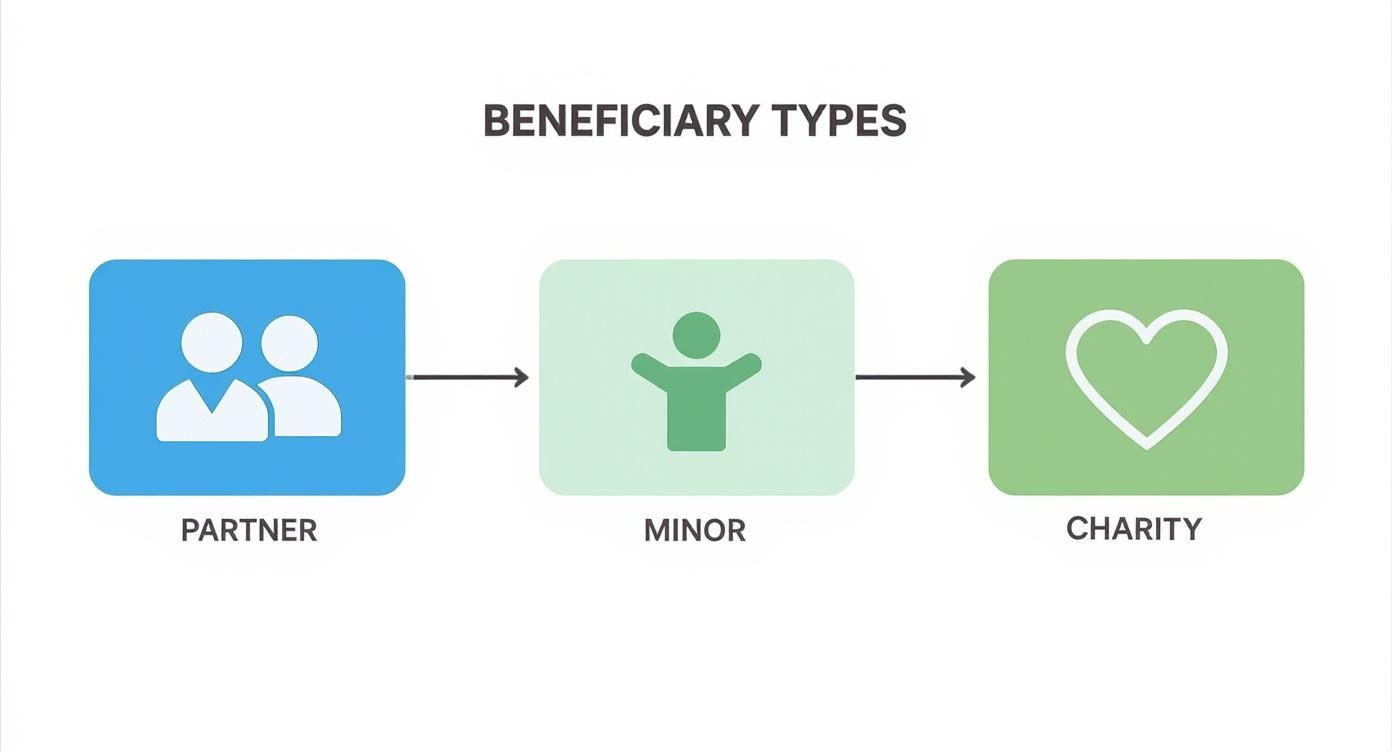
Whether you're looking out for a partner, a child, or even a charity, putting the policy in trust just makes the whole process smoother and faster.
Minimising Inheritance Tax Legally
The second significant benefit relates to Inheritance Tax (IHT). In the UK, if the total value of your estate is above the current £325,000 threshold, it could face a 40% tax bill. A substantial life insurance payout can easily push an estate over this limit.
However, when a policy is written in trust, the payout is not considered part of your estate for IHT purposes. It is a completely legal and common strategy used to ensure every penny you intended for your family reaches them, rather than being paid to HMRC.
Despite these powerful benefits, a shocking 90% of UK adults have either not placed their life insurance in trust or are unsure if they have. As the 2025 Drewberry Individual Protection Survey highlights, this simple oversight often leads to unnecessary delays and tax bills, eroding the financial security you worked to build.
Types of Trusts Explained
When you explore trusts, you will generally encounter two main types, each offering a different level of control:
- Absolute Trust: This is the most straightforward option. You name your specific beneficiaries from the start, and these choices cannot be changed later. It is ideal if you are certain about who should benefit and in what proportions.
- Discretionary Trust: This type offers more flexibility. You can list a wider group of potential beneficiaries (e.g., "my children and grandchildren"), and your trustees have the discretion to decide who receives what and when, based on their needs and circumstances at the time of your death.
Using a trust is a powerful financial planning tool. For a more detailed walkthrough, please see our in-depth guide on putting life insurance in trust. It is a small amount of paperwork that can make a significant difference to your family's future.
Updating Beneficiaries After Major Life Events
Think of your life insurance policy as a living document, not something to be filed away and forgotten. It needs to evolve alongside you. One of the most critical aspects of keeping it relevant is regularly reviewing who you have named as your beneficiary.
Life is full of changes, and major events can reshape your priorities and alter who depends on you financially. A beneficiary choice that made perfect sense five years ago might be entirely unsuitable today.
Forgetting to update your beneficiaries is not a minor slip-up; it can cause genuine distress. For example, the payout you intended for your current family could accidentally go to an ex-spouse, simply because the paperwork was never updated. This is a real risk, but one that is easily avoidable.
Key Moments to Review Your Beneficiaries
Certain life events should prompt you to contact your insurer. These are the moments when a quick review can make all the difference to your family’s future security.
Here are the most common triggers you should not ignore:
- Getting Married or Entering a Civil Partnership: This is perhaps the most obvious trigger. You will almost certainly want to name your new spouse or partner as your primary beneficiary to ensure they are looked after.
- Having or Adopting a Child: A new child brings new responsibilities. This is the perfect time to add them as a contingent beneficiary or review your level of cover to ensure their future is secure.
- Divorce or Separation: This is absolutely crucial. You must remove an ex-partner as a beneficiary once you have separated. If you forget, they could still legally receive the entire payout, regardless of your current wishes.
- A Beneficiary Passes Away: If your primary beneficiary dies before you, you need to nominate a new one immediately. If you do not, the money will likely go to your estate, which can mean long and frustrating delays due to probate.
- Buying a Home: Taking on a mortgage is a major financial commitment. Reviewing your policy ensures your partner or family will not struggle with repayments if you are no longer around. Many people take out a decreasing term policy specifically to cover their mortgage for this exact reason.
How to Make Changes with Your Insurer
The good news is that updating your beneficiaries is usually a straightforward process. Most major UK insurers like Aviva, Legal & General, or Zurich have dedicated teams to help you with this.
You will typically just need to call them and request a ‘change of beneficiary’ or ‘nomination of beneficiary’ form. You complete it with the new details, send it back, and the change is made. Some providers now allow you to make these updates through an online portal, making it even simpler.
The UK life insurance market is continually evolving, with a growing demand for flexible policies and digital services. Despite these advancements, the responsibility remains with you to be proactive. Projections show that individuals in the UK will spend an average of US$4,040 per person on life insurance in 2025, demonstrating how much we value financial protection.
If you are interested in the data, you can discover more insights on the UK insurance market from Statista.com. This level of investment underlines why it is so important to get the fundamentals right—like keeping your policy details current—to ensure your money protects the people it is intended for.
Common Beneficiary Mistakes and How to Avoid Them

Even with the best intentions, a small oversight when naming a beneficiary can cause serious problems later on. Getting these details right is crucial if you want to ensure your wishes are followed precisely.
By understanding the common pitfalls, you can take simple steps to protect your policy's payout and prevent unintended complications for your loved ones. These mistakes can cause frustrating delays, legal disputes, and financial strain at what is already a deeply difficult time. Thankfully, they are all easily preventable with a little proactive planning.
Forgetting to Be Specific
One of the most frequent errors is being too vague. Naming "my children" or "my spouse" on a form might seem clear to you, but it can create legal ambiguity. What if you remarry or have more children after completing the form?
How to avoid it: Always use the full legal names and dates of birth for every beneficiary. This simple step removes any doubt about your intentions and makes it easy for the insurer to identify the correct person without any issues.
Think of a beneficiary designation as a legal instruction. Vague terms like "my wife" can force the payout into your estate, where it has to be sorted out by the courts—causing the very delays and costs you were trying to avoid.
Assuming Your Will Overrides Your Policy
This is a critical and surprisingly common misunderstanding. Many people believe their last will and testament automatically updates their life insurance beneficiaries. This is incorrect. A life insurance policy is a separate contract between you and your insurer.
The beneficiary named on that policy will receive the payout, regardless of what your will says.
Example: Imagine a man who named his mother as the beneficiary on his £100,000 policy when he first took it out. Years later, he married, had a son, and wrote a detailed will leaving everything to his wife and child. He never updated the policy. When he passed away, the full £100,000 legally went to his mother, not his young family, because the policy's designation superseded the will.
Failing to Name a Contingent Beneficiary
What happens if your primary beneficiary passes away before you? It is a sad thought, but a necessary one to plan for. Without a backup, or contingent, beneficiary in place, the payout will likely default to your estate.
This means the money gets tangled up in probate and becomes subject to potential Inheritance Tax.
How to avoid it: Always name at least one contingent beneficiary. This creates a vital safety net, ensuring the money will still go directly to your next choice—perhaps your children, a sibling, or a close friend—without being tied up in legal processes. Think of it as your Plan B for protecting your family’s financial future.
Frequently Asked Questions (FAQ)
Here are clear, direct answers to the most common questions we hear about the life insurance beneficiary rules UK residents should know.
What happens if I don’t name a beneficiary?
If you do not name a beneficiary, the life insurance payout is paid into your legal estate upon your death. The money must then go through the legal process of probate, which can cause significant delays. The payout will also be counted as part of your estate for Inheritance Tax (IHT) purposes, which could result in a 40% tax charge on some or all of the money.
Can I change my life insurance beneficiary whenever I want?
Yes, in most cases you can change your beneficiary at any time. Major life events like marriage, divorce, or the birth of a child are ideal times to review your policy. The main exception is if you have placed your policy into an 'Absolute Trust', which makes the beneficiary nomination irrevocable. Otherwise, it is usually a simple case of contacting your insurer for a form.
Does my will override my beneficiary nomination?
No. This is a common misconception. A life insurance policy is a separate contract. The beneficiary named on the policy is legally entitled to the proceeds, regardless of what is stated in your will. It is essential to keep both your will and your beneficiary nominations up to date.
Do beneficiaries pay tax on a life insurance payout?
The payout is generally received by the beneficiary free of Income Tax and Capital Gains Tax. However, it could be subject to Inheritance Tax. If the policy is not written in trust, the payout is added to your estate's value. If the total value exceeds the IHT threshold (currently £325,000), the payout could be taxed at 40%. Writing a policy in trust is the most effective way to protect it from IHT.
Getting Your Beneficiary Nomination Right
Understanding the life insurance beneficiary rules UK residents must follow is the key to ensuring your policy delivers on its promise: securing your family’s future.
Ultimately, you have two powerful decisions to make. First, choosing the right people to receive the payout. Second, deciding whether to place your policy in trust. Getting these two things right ensures the money avoids probate delays and potential tax bills, delivering crucial financial support exactly when your loved ones need it most.
Life changes, and your nominations should too. Regularly reviewing your choices after major events like a marriage, divorce, or the birth of a child is essential. An outdated nomination can lead to devastating consequences and can even override the clear instructions left in your will.
To ensure your wishes are fully accounted for, it is worth considering how your life insurance fits into a wider picture of holistic end-of-life care planning. A little proactive planning now prevents significant complications later, giving you the peace of mind that your policy will work exactly as intended.
If you wish to learn more about the tax implications, our guide on what is Inheritance Tax is a great place to start.
Take control of your family's financial security today. At Discount Life Cover, we make it easy to compare quotes and find the right protection.
Get Your Free, No-Obligation Quote Now
This article is for information purposes only and does not constitute financial advice. Discount Life Cover is not providing personalised recommendations. Insurance policies vary depending on individual circumstances. For advice tailored to your situation, please speak with a qualified financial adviser or request a personalised quote.
Leave a Reply