A Guide to UK Income Protection Cover
Published

Imagine your monthly paycheque just… vanished. How would you cover the mortgage, the bills, or even the weekly food shop? That terrifying thought is exactly why income protection cover exists. It’s a financial safety net designed to catch you if illness or injury stops you from working.
Think of it as your own private sick pay plan.
What Is Income Protection And Why Does It Matter?
Your ability to earn a living is probably your single biggest asset. It’s the engine that powers your entire life, from keeping a roof over your head to saving for the future. Yet, a sudden illness or an unexpected injury could put that engine on standby indefinitely, creating huge financial and emotional strain.
This is the problem income protection was created to solve. Unlike other types of insurance that can feel a bit abstract, its purpose is crystal clear.
An income protection policy pays you a regular, tax-free monthly income—usually between 50% and 70% of your gross salary—if you’re signed off work by a doctor. This keeps the money coming in, so you can focus on getting better without worrying about the bills.
The Growing Need For A Financial Safety Net
Relying on savings or state benefits alone is a risky game. While building a robust emergency fund is a cornerstone of good financial health, it’s really only designed for short-term hiccups, not a long-term absence from work.
And what about government help? Statutory Sick Pay (SSP) offers a minimal cushion, currently paying just over £116 a week for up to 28 weeks. For most people, that wouldn’t even touch the sides of their major expenses like rent or mortgage payments.
This stark reality is why more and more people are taking matters into their own hands. According to the Association of British Insurers (ABI), sales of new individual income protection policies soared to a record 247,000 in 2023, a massive 16% jump from the year before. Clearly, people are waking up to the need for a proper Plan B.
Income Protection vs Other Financial Safety Nets
It's easy to get income protection mixed up with other policies, but they all do very different jobs. Here’s a quick comparison to clear things up:
| Feature | Income Protection Cover | Critical Illness Cover | Statutory Sick Pay (SSP) |
|---|---|---|---|
| What It Pays | A regular monthly income (e.g., £2,000/month) | A one-off tax-free lump sum (e.g., £100,000) | A fixed weekly amount (currently ~£116.75/week) |
| When It Pays | When any illness or injury stops you from working | On diagnosis of a specific, serious condition listed in the policy | When you're too ill to work (employer-paid, state-mandated) |
| How Long It Pays | Can pay out for years, often until you return to work or retire | Pays out only once, after the initial diagnosis | For a maximum of 28 weeks |
| Best For | Replacing your salary for long-term sickness | Covering major one-off costs like mortgage debt or home adaptations | Basic, short-term support for a few months |
Understanding these differences is key to making sure you have the right protection for your family. Here’s a bit more detail.
How It Differs From Other Policies
Critical Illness Cover: This pays out a single, tax-free lump sum if you’re diagnosed with a specific serious condition defined in the policy, like a heart attack or certain cancers. The key word here is specific—it won’t cover you for every illness or injury that could stop you from working.
Accident, Sickness, and Unemployment (ASU) Cover: These are typically short-term plans, often paying out for a maximum of 12 or 24 months. While they can be a useful stopgap, they don’t provide the long-term security of a full income protection policy, which can potentially pay out until you hit retirement age. If you'd like to dig deeper, you can learn more about the specifics of accident and sickness insurance policies.
To put it simply, while critical illness cover gives you a lump sum for a specific life-changing event, income protection cover acts as a replacement salary for a much broader range of situations that stop you from earning.
How Your Income Protection Policy Actually Works
To feel confident about choosing income protection, you need to get under the bonnet and see how the different parts work. Think of these as the dials and levers you can adjust to build a plan that fits your life and your budget. Every element plays a big part in when your policy pays out, how much you get, and for how long.
First, let's see where income protection fits in the grand scheme of things.
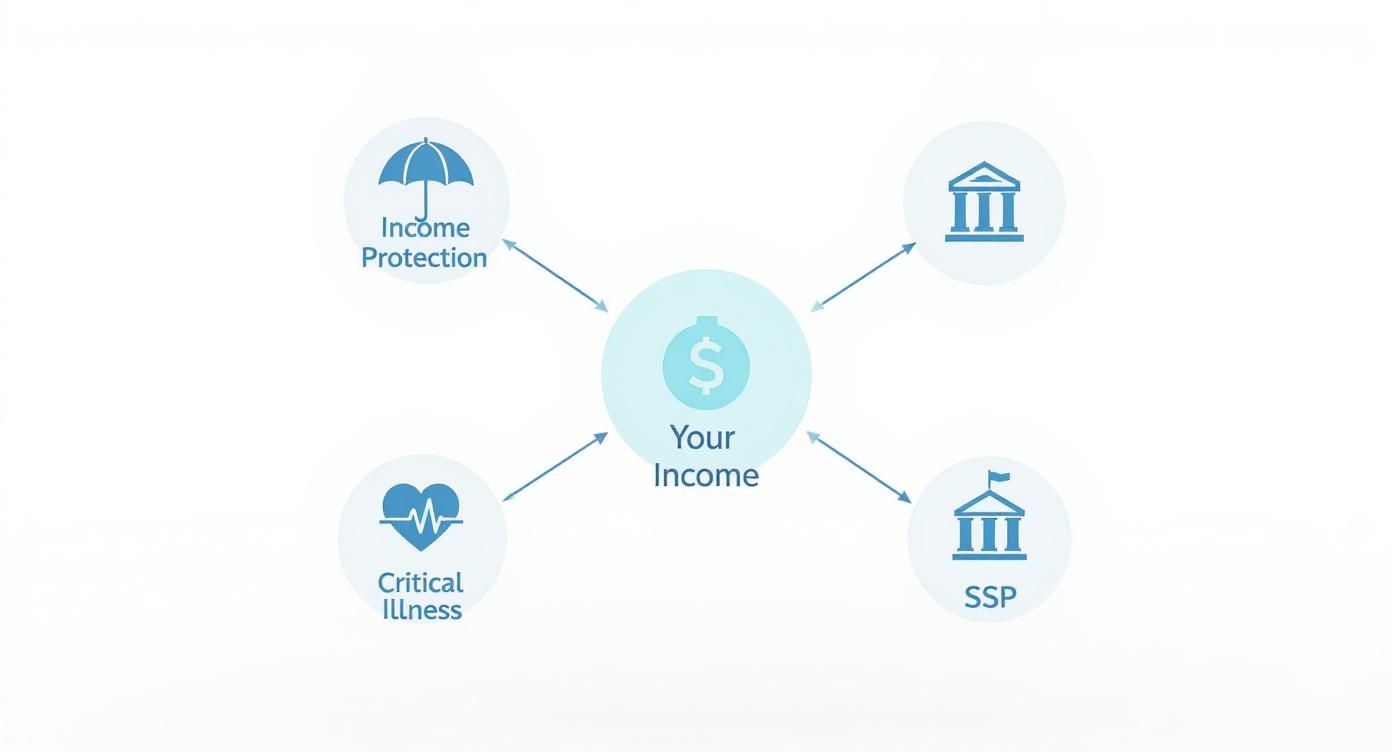
As you can see, while things like Statutory Sick Pay (SSP) and critical illness cover have their place, income protection is the one that steps in to replace your actual salary. It's the real umbrella for a rainy day.
The Deferred Period
The deferred period is just industry-speak for the "waiting period." It’s the amount of time you agree to wait between being signed off work and when the policy actually starts paying you. This is a critical feature that you're in control of.
You can usually pick a deferred period anywhere from four weeks up to a full year. A smart move is to line it up with whatever sick pay your employer offers. For example, if your company pays you in full for three months, you’d simply set a three-month deferred period on your policy.
Here’s the golden rule to remember: the longer the deferred period you choose, the lower your monthly premiums will be. That's because you're shouldering more of the initial financial risk yourself.
Level of Cover
This is all about the monthly, tax-free amount your policy will pay out. Insurers in the UK typically let you cover somewhere between 50% and 70% of your gross (pre-tax) income. And there’s a very sensible reason for that cap.
Insurers, who are regulated by the Financial Conduct Authority (FCA), set this limit to make sure there's still a financial incentive for you to get back to work when you're able to. It stops a situation where you might be financially better off staying at home than returning to your job.
Short-Term vs Long-Term Policies
When you're setting up your cover, you’ll come across two main types of payment periods:
- Short-Term Policies: You'll often see these branded as Accident, Sickness, and Unemployment (ASU) policies. They limit how long they'll pay out for any single claim, usually to one, two, or five years. They're , but they don't offer the same rock-solid security if you're hit with a long-term condition.
- Long-Term Policies: This is the real deal—the most comprehensive form of income protection. This type of policy will keep paying you a regular income until you either return to work, the policy term ends (usually at retirement age), or you pass away. It provides genuine peace of mind against a career-ending illness.
Thinking about the details of a policy, people often wonder about eligibility, especially in niche situations like the disability insurance eligibility for those who haven't worked. Your employment history is definitely a key factor that insurers will look at.
Definitions of Incapacity
This is probably the most important bit to get right. You need to understand exactly how the policy defines being "unable to work." This isn't some vague idea; it's a specific, legally binding definition written into your contract. The best one you can get is 'Own Occupation'.
Own Occupation: This is the gold standard. It means the policy pays out if you are unable to do your specific job. For specialists like surgeons, electricians, or pilots, this is non-negotiable, as their skills aren't easily transferred to another role.
Suited Occupation: This definition is a bit weaker. It means your insurer will only pay out if you can't do your own job or any other job you are suited to based on your skills and experience. It leaves a lot more room for interpretation.
Any Occupation: This offers the competitive level of protection. You’d only get a payout if you are so ill or injured that you couldn’t perform any kind of work whatsoever.
Always, always check this definition before you sign anything. It makes a massive difference to how likely your policy is to pay out when you really need it to.
Pinpointing Who Needs Income Protection Most
It’s easy to think income protection is just for people in risky jobs or those with a taste for adrenaline-fuelled hobbies. But the reality is much, much broader. If your lifestyle relies on your monthly paycheque, you should be asking yourself what would happen if it suddenly vanished. This isn't about being pessimistic; it's about being prepared for life's curveballs.
The hard truth is that a long-term illness or an unexpected injury can happen to anyone, at any time, no matter what they do for a living. The real danger isn't just the health issue itself—it's the financial chaos that follows when you can't work.

The Self-Employed and Freelancers
When you work for yourself, you are the safety net. There's no employer sick pay to cushion the blow, and Statutory Sick Pay isn't an option. Think about a self-employed graphic designer, a freelance consultant, or a tradesperson—their income is directly tied to their ability to show up and do the work.
An illness that knocks them out of action for a few months could be financially devastating. For this group, income protection cover isn't just a "nice-to-have." It’s a core part of a smart business plan, making sure the mortgage and the business bills still get paid.
Families and Homeowners
For anyone with a mortgage to pay and kids to look after, the stakes are incredibly high. It doesn't matter if you're a single-income household or a family relying on two salaries; losing one of those incomes can throw your finances into a tailspin.
Picture a young family whose mortgage payments, childcare costs, and weekly shop are all budgeted around two specific incomes. If one parent can't work for an extended period, the financial pressure can become immense, potentially even putting their home at risk.
The economic fallout from health-related income loss is a massive issue. In fact, some analysis suggests that over half of working-age Brits might need to claim on an illness protection policy before they retire. This really hammers home how disruptive it can be when a serious illness makes an income disappear. Learn more about these findings.
This is why income protection is a cornerstone of financial security for anyone with dependents or big commitments like a mortgage.
Workers in Physically Demanding Roles
While an office worker is certainly not immune to getting sick, people in physically demanding jobs face a whole different set of risks. A builder, a nurse, a dentist, or a chef depends on their physical health to do their job day in, and day out.
An injury that might be a minor inconvenience for someone at a desk could be career-threatening for them. A bad back, a broken wrist, or a repetitive strain injury could mean months off the tools with zero income. For these professionals, having a solid Plan B is absolutely essential.
So, Who Really Needs It?
At the end of the day, the question isn't "who is most likely to get ill?" It’s "who would be hit hardest financially if they couldn't work for a long time?".
You should seriously be thinking about income protection if you:
- Are self-employed and have no access to employee benefits.
- Have dependents who rely on your income to live.
- Have a mortgage or other big debts that need paying every single month.
- Get very little sick pay from your employer (or none at all).
- Don’t have enough savings to cover your bills for more than a couple of months.
If your monthly earnings are what keeps your and your family's life on track, then protecting that income should be a top priority.
Decoding the Cost of Your Premiums
Ever wondered what actually goes into the price of your policy? When you get a quote for income protection, the monthly premium isn't just a number plucked from thin air. UK insurers go through a detailed process called underwriting to figure out your personal level of risk, making the price a personalised calculation rather than a mystery.
Understanding the key things that influence this calculation is powerful. It shows you exactly why your quote is what it is, and it also lets you see which levers you can pull to find that sweet spot between great cover and a price that fits your budget.
Your Personal Circumstances
First and foremost, the biggest part of the puzzle is you. Insurers look at a handful of personal details to get a clear picture of your risk profile.
Your Age: This is a big one. The younger and healthier you are when you take out a policy, the your premiums will usually be. It's a simple matter of statistics – you're less likely to fall ill and need to make a claim.
Your Health and Lifestyle: Insurers will ask quite a few questions about your medical history, especially any pre-existing conditions. They'll also want to know if you smoke or vape, as this significantly bumps up the health risks and, you guessed it, the cost of your cover.
Your Occupation: Your job plays a massive part. An office-based accountant will almost always pay less than a roofer or a scaffolder. Insurers group jobs into different risk classes based on how likely an injury or illness is in that line of work.
Your Policy Choices
Beyond your personal details, the choices you make when setting up your policy have a direct and immediate impact on what you pay each month. Think of these as the dials you can turn to get the right level of cover at a price you're comfortable with.
These factors pretty much influence the cost of any type of personal protection. If you want to take a deeper dive into pricing, our guide on how much life insurance costs explains these principles in more detail, as they across the board.
The most direct way to manage the cost of your premiums is by adjusting your policy's structure. Opting for a longer deferred period or a lower percentage of income cover will immediately reduce your monthly payments.
To give you a clearer idea, here’s a table showing how different choices can affect your monthly premium.
Example Monthly Premiums for Income Protection
These are just illustrative examples for a non-smoker looking for a £2,000/month benefit paid out until they reach age 65. It really highlights how your job and the deferred period can swing the price.
| Profile | Deferred Period | Occupation Type | Estimated Monthly Premium |
|---|---|---|---|
| 35-year-old Accountant | 13 weeks | Low Risk (Office-based) | £25 |
| 35-year-old Accountant | 26 weeks | Low Risk (Office-based) | £20 |
| 35-year-old Roofer | 13 weeks | High Risk (Manual Labour) | £70 |
| 35-year-old Roofer | 26 weeks | High Risk (Manual Labour) | £55 |
As you can see, simply doubling the waiting period can knock a decent amount off the premium, and the difference between an office job and a manual trade is significant.
Key Policy Levers That Affect Cost
Let's break down the specific policy features you control and how they tweak the final price you pay:
The Deferred Period: This is the waiting time before your payments kick in. A longer deferred period (say, six months instead of four weeks) means lower premiums because you’re covering that initial spell of sickness yourself. A smart move is to line this up with your employer's sick pay scheme to avoid paying for cover you don’t need yet.
The Level of Cover: This is the slice of your gross income you choose to protect, which is typically between 50% and 70%. Covering a smaller percentage, like 50%, will naturally be than going for the maximum 70%.
The Policy Term: Deciding how long you want the policy to last is another key decision. A policy that runs until you are 68 will cost more than one that stops at age 60. Why? Simply because the risk of a claim goes up as you get older.
Premium Type: You'll have a choice between competitive or reviewable premiums. premiums are locked in for the entire life of the policy, which is great for predictability. Reviewable premiums start off but can increase over time, potentially becoming much more expensive down the road.
By getting to grips with how these elements work together, you can confidently build an income protection cover policy that gives you a solid safety net without putting a strain on your finances.
Navigating the Claims Process with Confidence
One of the biggest worries people have about any insurance is simple: will it actually pay out when I need it? It’s a fair question. The good news is that for income protection cover, the answer is overwhelmingly positive. Insurers are in the business of paying valid claims, and UK industry data consistently shows they do just that.
This provides vital financial support to thousands of families every single year. Let's walk through what the claims journey typically looks like, so you can feel confident that the process is straightforward and designed to help.

A Step-by-Step Look at Making a Claim
When you're unwell, the last thing you need is a complicated process. Insurers get this, and they’ve made submitting a claim as clear as possible. While the exact details can vary a bit between providers, the core steps are pretty much the same everywhere.
Notify Your Insurer: As soon as you know you'll be off work for longer than your policy's deferred period, get in touch with your insurer. They'll send you a claim form to kick things off.
Complete the Paperwork: You'll need to provide your personal details, some information about your job, and the reason you can’t work. Your employer might also need to fill in a section to confirm your salary and any sick pay arrangements.
Provide Medical Evidence: This is the most important part. Your insurer needs confirmation from your GP or specialist about your condition, how it stops you from working, and roughly how long you're expected to be off. This is where being totally honest during your initial application really pays off, as it helps make sure everything goes smoothly.
Assessment and First Payment: The insurer's claims team will then review all the information. Once they've approved your claim, your payments will start as soon as your deferred period is over. These payments will keep coming until you're well enough to go back to work, or until your policy term ends.
The Real-World Impact of a Successful Claim
The true value of income protection isn't just about the numbers on a spreadsheet; it's about the stability and peace of mind it gives you during a really tough time. The leading causes for long-term absence from work in the UK are often things like musculoskeletal issues (think severe back pain) and mental health conditions.
These are exactly the situations where a policy shines, offering long-term support that other types of insurance might not touch. For example, recent data from Aviva showed the company paid out a staggering £1.18 billion across various protection claims in a single year, with a big chunk of that going to income protection. The data also highlighted one of their longest-running claims, which supported a policyholder for over 38 years for mental health reasons. That shows the profound, long-term difference this cover can make. You can discover more about Aviva's claims performance if you're interested.
By replacing a significant portion of your salary month after month, the policy allows you to focus completely on your recovery, free from the stress of mounting bills or the risk of falling into debt.
This is the tangible, real-world difference that a well-chosen income protection cover policy makes. It transforms a potential financial crisis into a manageable situation, protecting not just your bank balance but your overall wellbeing.
Finding and Applying for the Right Cover
Taking that first step to protect your income might feel like a big deal, but honestly, the application process is more straightforward than most people think. As long as you have the right information to hand, you can sail through it and find a policy that gives you genuine peace of mind. The trick is to be prepared and, most importantly, completely open with the insurer.
Think of the application as a detailed questionnaire. Insurers just need to get a clear picture of who you are, what you do for a living, and your current state of health. This allows them to accurately work out the risk and calculate your premium.
What You Will Need to Provide
To kick things off, you'll need to gather some basic information. Having this ready will make everything go much more smoothly.
- Personal Details: This is the easy bit – your full name, date of birth, and address.
- Occupation Details: You’ll need to state your exact job title, what your day-to-day duties involve, and your annual income. If you're self-employed, you'll likely need to show evidence of your earnings from the last one to three years.
- Health and Lifestyle Information: Be ready for questions about your height, weight, medical history (both yours and your family's), and whether you smoke or vape.
Complete honesty during your application is absolutely non-negotiable. It might be tempting to hold back information about a pre-existing condition to get a premium, but it could completely invalidate your policy when you need to make a claim. That would leave you with no cover at all, right when you need it most.
Medical Checks and GP Reports
Sometimes, an insurer will need a little more detail. If you mention a specific medical condition or if you're ing for a particularly high level of cover, they might ask for one of two things:
- A Medical Examination: This is usually just a simple check-up with a nurse, often arranged at a time and place that suits you, to confirm things like your blood pressure and cholesterol levels.
- A GP Report: With your permission, the insurer may write to your GP to get a clearer understanding of your medical history.
Don't worry, this is a standard part of the underwriting process. It’s simply there to make sure your cover is priced correctly and is completely watertight if you ever need to rely on it.
Comparing Quotes and Getting Advice
Once you have your info ready, it’s time to start looking at your options. While comparison sites can give you a rough idea of cost, they often don't highlight the crucial differences in policy definitions, like whether you're getting 'Own Occupation' cover. This is a massive detail that can make or break a claim.
This is exactly where speaking to an expert can be a game-changer. An independent adviser can help you make sense of the small print and find the perfect balance of features and cost for your specific situation. Given how vital this decision is, many people prefer to get proper guidance. You can explore the 10 reasons to use a life insurance broker to see just how expert advice can simplify the whole thing and help you secure the best possible income protection cover.
Frequently Asked Questions
Dipping your toes into the world of insurance can throw up a lot of questions. To make sure you feel completely clear and confident, we’ve put together some straightforward answers to the queries we hear most often about income protection cover.
Are Payouts From Income Protection Tax-Free?
Yes, they are. Under current UK tax law, any monthly payments you receive from a personal income protection policy are paid completely tax-free. This is because you pay your monthly premiums from your post-tax salary. The benefit is designed to replace a slice of your take-home pay, so the amount you’re quoted is exactly the amount you'll get in your bank account.
Can I Get Cover If I Am Self-Employed?
Absolutely. In fact, for anyone who's self-employed, income protection is an incredibly important bit of financial kit. With no access to employer-provided sick pay, it’s all on you. Insurers will typically ask for evidence of your earnings over the last one to three years to figure out the level of cover you can get, which you can usually prove with finalised accounts or SA302 forms from HMRC. The policy works in exactly the same way, providing a crucial financial lifeline if you’re ever unable to work.
Should I Choose or Reviewable Premiums?
This is a key decision that affects the long-term cost of your policy.
- premiums are fixed for the entire life of your policy. They might look a little more expensive at the start, but you get the certainty of knowing your payments will never go up.
- Reviewable premiums often seem initially, but the insurer has the right to increase the cost over time. They can end up becoming much more expensive in the long run.
For long-term budgeting and peace of mind, competitive premiums are usually the better option.
What Happens to My Policy If I Change Jobs?
Your personal income protection cover is tied to you, not your employer, so it stays with you no matter where you work. You do, however, have to let your insurer know if you change your occupation. Moving into a job that the insurer sees as higher-risk could affect your policy, so it’s vital to keep them in the loop.
Feeling clearer about how income protection cover could work for you? The easiest way to see what your options look like is to get a personalised quote. At Discount Life Cover, we make it simple to compare policies from leading UK insurers, helping you find the right protection at the right price.
Get your free, no-obligation quote from Discount Life Cover today!
This article is for information purposes only and does not constitute financial advice. Discount Life Cover is not providing personalised recommendations. Insurance policies vary depending on individual circumstances. For advice tailored to your situation, please speak with a qualified financial adviser or request a personalised quote.