
As you approach retirement, thinking more about your health and wellbeing becomes a priority. For many, over 65 health insurance is a key part of that conversation in the UK.
It's a way to get faster access to medical treatments and have more choice over your care. Think of it as a helpful addition to the fantastic service we all get from the NHS, not a replacement. It's there to add an extra layer of reassurance for non-urgent procedures.
Navigating Your Healthcare Options After 65

Turning 65 is a real milestone, and it often brings new questions about managing your healthcare for the years ahead. The NHS provides an excellent foundation of care for everyone in the UK, but you might be wondering if private health insurance is a sensible idea for your own peace of mind.
This guide will walk you through the essentials of private medical cover for seniors. We'll explain how it works, what it usually covers, and how it can fit into your retirement plans, giving you clear, impartial information to help you decide if it's the right choice for you.
Why Consider Private Health Insurance in Retirement?
The main reason people over 65 look into private options is to gain more control and speed when it comes to non-emergency medical care. While the NHS is exceptional for urgent treatment and managing long-term conditions, waiting lists for procedures like hip replacements or cataract surgery can sometimes be lengthy.
Here are the key benefits that appeal to retirees:
- Bypass Waiting Lists: Get quicker access to eligible treatments, helping you get back to enjoying your retirement sooner.
- Greater Choice and Comfort: You often get more say over where and when you're treated, with the option of a private room for a more comfortable recovery.
- Access to Specialist Care: A policy can open the door to prompt specialist consultations and advanced diagnostic scans like MRIs or CTs.
- Peace of Mind: Simply knowing you have a plan in place for prompt medical attention can reduce a lot of worry for both you and your family.
It's best to see private health insurance as a complementary tool. It works alongside the NHS, giving you a 'fast-track' option for specific medical needs without ever affecting your right to use NHS services.
It's always wise to understand all your protection options. While health insurance covers medical treatment costs, you might also want to learn more about how a comprehensive life insurance policy can provide financial security for your loved ones.
How Private Cover Works Alongside the NHS
One of the most common questions we hear is: if I get private health insurance, do I lose my right to use the NHS? The answer is a simple and emphatic no. Taking out a private policy doesn’t mean you’re giving up your access to the National Health Service. The two systems are designed to work hand-in-hand.
Think of the NHS as the bedrock of your healthcare. It’s always there for every UK resident, handling emergencies, GP visits, managing long-term conditions like diabetes or high blood pressure, and much more. It is, and always will be, your primary source of care.
Private health insurance is an added layer of convenience on top of that solid foundation. It’s your 'fast-track pass' for specific, non-emergency treatments that are included in your plan. You remain an NHS patient with full access to everything it offers, but you also gain another option for speed and choice when you might need it most.
A Partnership in Your Healthcare
The best way to view the relationship between the NHS and private healthcare is as a partnership. Your journey into private treatment will almost always start with your local NHS GP. They'll be your first port of call, and if they feel it’s right for your condition, they can provide a referral to a private specialist.
That’s where your private policy steps in, picking up the costs for the consultations, diagnostic tests, and the procedure itself. Once your private treatment is complete, you’ll return to the care of your NHS GP for any follow-up or ongoing management. You can weave between the two systems as needed, making sure you get the right care at the right time.
Real-World Scenarios
Seeing how this plays out in real life makes it much easier to understand. Let’s walk through a couple of common situations for people over 65.
- Cataract Surgery: You start noticing your vision isn't what it used to be, and your GP diagnoses cataracts. You can join the NHS waiting list for the operation. But a private policy could mean seeing a specialist in a matter of weeks and having the surgery at a hospital and time that suits you.
- Hip Replacement: If you're dealing with persistent joint pain and a consultant confirms you need a hip replacement, the NHS waiting list can be quite long. With private insurance, you could potentially schedule that surgery far sooner, cutting down the time you spend in discomfort and getting you back on your feet and enjoying life again.
This chart gives a visual breakdown of how these different healthcare models fit together.
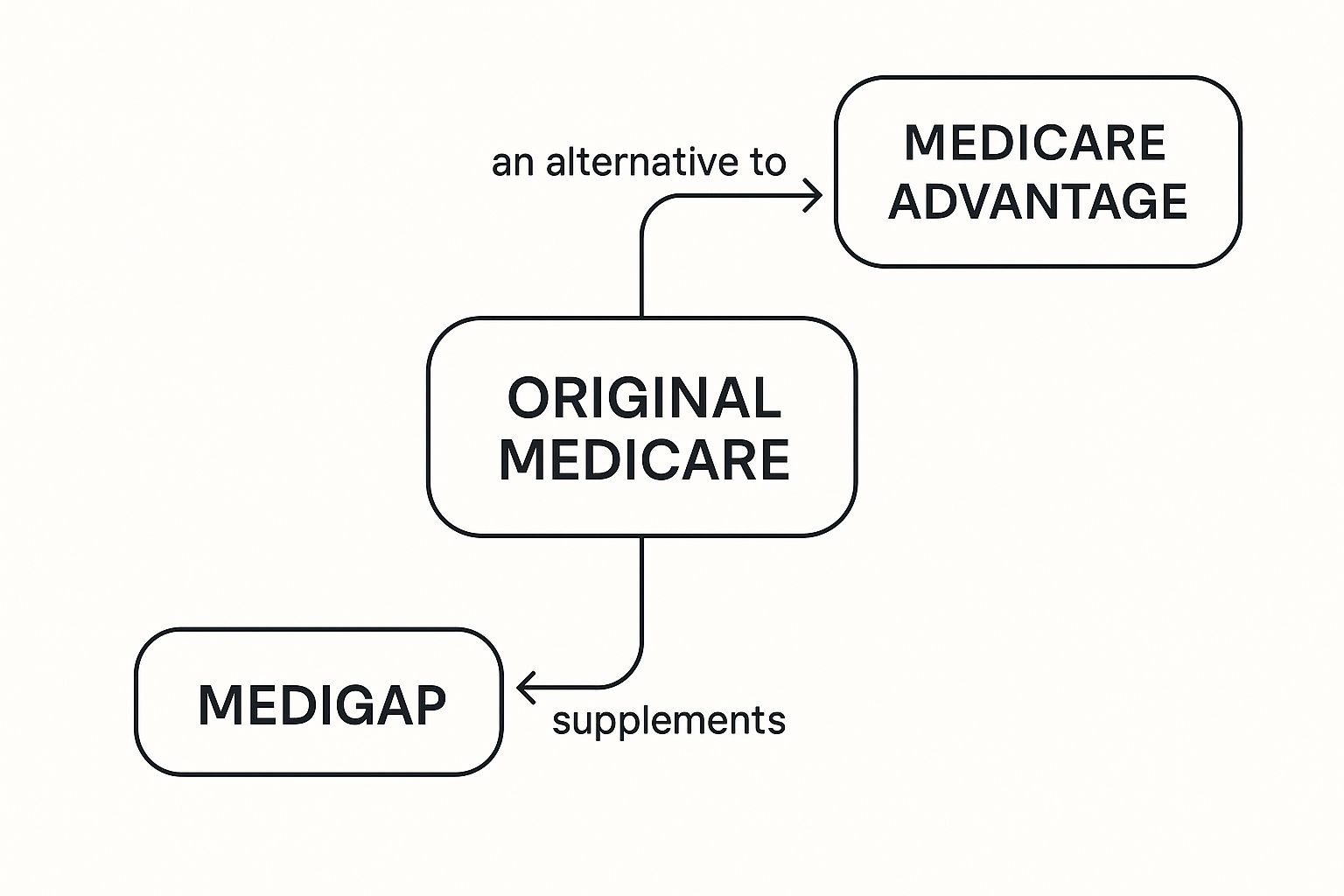
As you can see, it's about adding specific layers of cover on top of the core healthcare system we all rely on.
Retaining Your Full NHS Rights
It’s crucial to remember that your access to NHS services is always protected. This is especially true for accident and emergency care, which private medical insurance does not cover. If you have an accident or a sudden medical crisis, you head straight to your local A&E, just like everyone else.
Your private policy is built for planned, non-urgent medical treatment. It complements the NHS by offering quicker access and greater choice for certain conditions, but it never replaces the critical, life-saving care the NHS provides.
Comparing NHS and Private Healthcare Services for Seniors
To give you a clearer picture, let's look at a side-by-side comparison of what the NHS typically covers versus what a private health insurance policy might offer for older adults.
| Service or Treatment | Covered by NHS | Typically Covered by Private Insurance |
|---|---|---|
| GP Appointments | Yes, fully covered. | Sometimes offered as an add-on (e.g., virtual GP services), but your NHS GP remains your primary contact. |
| Emergency Care (A&E) | Yes, comprehensive cover for all emergencies. | No, this is exclusively handled by the NHS. |
| Elective Surgery | Yes, but often involves waiting lists (e.g., hip/knee replacements, cataract surgery). | Yes, a key benefit is skipping waiting lists for eligible procedures at a private hospital of your choice. |
| Chronic Condition Care | Yes, ongoing management for conditions like diabetes or arthritis. | No, long-term chronic conditions are usually excluded. |
| Diagnostic Tests | Yes, scans like MRIs or CTs are covered but may have waiting times. | Yes, provides fast access to diagnostics to speed up a diagnosis. |
| Cancer Treatment | Yes, provides a full range of treatments. | Yes, often provides access to drugs or treatments not yet available on the NHS. |
| Physiotherapy | Yes, but access can be limited with long waits for appointments. | Yes, often includes a set number of sessions per year with quick access. |
| Dental & Optical | Basic services are available, but many treatments require patient contributions. | Not typically standard, but can be added to many policies as an optional extra. |
This table highlights the complementary nature of the two systems. One isn't a replacement for the other; they simply serve different purposes in your overall healthcare plan.
To dig deeper into how costs and access can vary, it's useful to look at specific examples. This guide on emergency dental costs across NHS and private providers offers a great breakdown, showing exactly how the two systems operate differently for certain treatments.
What a Typical Over 65 Policy Covers
When you first start looking at over 65 health insurance policies, it's easy to get lost in the jargon. To feel confident in your choice, you need to know what you're actually getting for your money. Let's break down the common parts of a private medical insurance policy, starting with the essentials and moving on to the optional extras.
Most policies are built around a core benefit called in-patient cover. This is the foundation of any plan. It covers you for treatments that need a hospital bed, whether that's overnight or just for the day. Think of it as your safety net for any significant medical procedures.
This core cover usually includes things like:
- Hospital accommodation and nursing care: This pays for your private room and the professional care you'll receive during your stay.
- Surgeon and anaesthetist fees: The policy will handle the costs for the medical team performing your operation.
- Specialist consultations and diagnostic tests: This covers things like blood tests or X-rays that are necessary while you're admitted to hospital.
Understanding Out-Patient Cover
Of course, many health issues begin long before a hospital stay, with appointments and tests. This is where out-patient cover steps in. As the name suggests, this part of the policy covers you for medical care that doesn't require you to be admitted to hospital.
For instance, imagine you develop persistent knee pain. Your GP might refer you to an orthopaedic specialist. With out-patient cover, your policy could pay for that initial consultation and any scans, like an MRI, needed to get to the root of the problem without a long wait.
This is often an optional add-on, giving you the flexibility to decide how much cover you need. Some policies might offer a set number of consultations per year, while others will have a financial limit on how much you can claim.
Common Inclusions in a Senior Health Policy
To see how this all fits together, let's look at what's typically included in a standard policy. While every plan from insurers like Bupa, Aviva or AXA is different, most are designed to cover acute conditions—that is, illnesses or injuries that are short-term and likely to improve with treatment.
Here are some of the key benefits you can often expect to see:
- Prompt access to diagnostic scans: This includes MRI, CT, and PET scans, helping your specialists diagnose your condition without delay.
- A choice of hospitals: Policies usually have an approved list of private hospitals you can choose from for your treatment.
- Cancer cover: This is a vital part of most policies, often providing access to specialist treatments, drugs, and therapies that might not be available on the NHS.
- Mental health support: Many insurers now offer support for mental health, including access to counselling or psychiatric services.
- Post-treatment therapies: This can include physiotherapy or osteopathy to help you recover after a procedure, like a fall or joint replacement.
What is Usually Excluded
Just as vital as knowing what's covered is understanding what isn't. Being realistic about a policy's limitations helps you avoid nasty surprises down the line. It's important to remember that private health insurance isn't designed to cover every eventuality.
The golden rule of private medical insurance is that it covers acute conditions, not chronic ones. An acute condition can be cured with treatment, whereas a chronic condition is long-term and needs ongoing management.
Here are the most common exclusions you'll find in almost every policy:
- Pre-existing conditions: Any medical issue you had before you took out the policy will usually be excluded, at least for an initial period.
- Chronic conditions: Long-term illnesses like diabetes, asthma, or high blood pressure will continue to be managed by your NHS GP.
- Emergency services: As we've mentioned, A&E treatment is always handled by the NHS.
- Cosmetic surgery: Procedures that are not medically necessary will not be included.
- Routine dental and optical care: Standard check-ups are typically excluded unless you add a specific dental and optical benefit to your plan.
Understanding these differences is crucial. It’s also important to know that health insurance works differently from other protection policies. While it covers treatment costs, it doesn't provide a cash payout if you fall ill. For that kind of financial safety net, you would need to look at options like critical illness cover, which can work alongside your health insurance.
Understanding the Cost of Senior Health Insurance
For most people heading into retirement, the biggest question mark over private health insurance is whether they can afford it. It's a fair question, so let's get straight to it. The truth is that premiums for over 65 health insurance are higher than for younger people, for a simple reason.
Insurers, who are regulated by the Financial Conduct Authority (FCA), price their policies based on risk. As we get older, the chances of needing medical care naturally go up. This means there's a higher likelihood of making a claim, and insurers must factor that increased risk into their pricing.
However, a higher premium doesn't have to mean it's out of reach. The key is to understand what drives the cost, which is the first step to finding a plan that fits comfortably within your retirement budget.
Key Factors That Influence Your Premium
Think of your premium as being built from several different blocks. Insurers look at a handful of key factors when they put together your quote. While you can’t change your age, you might be surprised by how much control you have over the other elements.
The main factors are:
- Your Age: This is the most significant factor. The older you are, the higher the statistical risk, and the more your premium will be.
- Your Location: Private medical costs aren't the same everywhere in the UK. Treatment in central London, for instance, is usually more expensive than elsewhere, and your postcode will be reflected in the price.
- The Level of Cover: A top-tier plan with all the optional extras, like extensive out-patient benefits and a huge choice of hospitals, will naturally cost more than a basic policy focused purely on in-patient care.
- Your Medical History: Although pre-existing conditions are nearly always excluded, your general health history can sometimes play a part, depending on how the policy is underwritten.
There’s no getting around it: costs rise as we age. Research shows that a 70-year-old in the UK can expect to pay around five times more for the same private health insurance policy than a 20-year-old. It's a significant financial commitment, but it buys you faster access to specialists. Plus, there are ways to manage this cost – choosing a higher excess, for example, can often reduce your premium by around 20%.
Actionable Strategies to Manage the Cost
Knowing what affects the price is one thing; using that knowledge to your advantage is how you make a policy affordable. You have several levers you can pull to shape a plan to your budget without giving up the essential cover you want.
Here are three of the most effective strategies:
- Adjust Your Excess: The excess is the amount you agree to pay towards any claim before the insurer steps in. By choosing a higher excess (say, £500 instead of £250), you're signalling to the insurer that you'll only claim for more serious issues. This lowers their risk and can bring your premium down.
- Choose a 'Six-Week Wait' Option: This is a very smart way to save money. With this option, your policy only activates if the NHS waiting list for the in-patient treatment you need is longer than six weeks. If it's shorter, you use the NHS. Because this reduces the number of potential claims, it can make your cover much more affordable.
- Select a Guided Consultant List: Some insurers, like Aviva or Bupa, will offer a discount if you agree to choose your specialist from their curated list of consultants. You might have slightly less choice, but the consultants are all highly qualified, and the savings can be well worth it.
These adjustments are all about finding the right balance between cost and cover. The goal isn't just to find the cheapest policy, but the one that offers the best possible value for your personal situation and budget.
When mapping out your healthcare budget, don't forget other potential costs. Things like medical devices might not be fully covered by a standard policy, so it pays to understand the costs of invisible hearing aids and their insurance coverage, for example. And while health insurance is for treatment, it's also wise to get a sense of what other financial protections cost. Our guide on how much life insurance costs can help give you a more complete financial picture.
Navigating Pre-Existing Conditions and Eligibility

One of the biggest worries we hear from people looking at over 65 health insurance is: "Will my past health problems stop me from getting cover?" It’s a perfectly reasonable question. By the time we reach our mid-sixties, most of us have some medical history.
The good news is that having a pre-existing condition doesn't automatically prevent you from getting cover. Insurers have established ways of handling this, and once you understand how they work, you can approach an application with more confidence.
What Insurers Call a Pre-Existing Condition
In simple terms, a pre-existing condition is any illness, injury, or symptom you've seen a doctor about, had a diagnosis for, or received treatment for before your new policy starts. It could be anything from high blood pressure managed with daily tablets, to a hip replacement you had a few years ago.
Insurers need to know about these things to determine what your policy can and can't cover. To do this, they typically use one of two methods for 'underwriting' – their process for assessing your application.
Understanding Moratorium Underwriting
The most common approach is moratorium underwriting. It sounds technical, but the idea is quite simple.
With a moratorium, you don't have to fill out pages of medical history forms. Instead, the insurer automatically excludes any conditions for which you've had symptoms, treatment, or medical advice in the last five years.
The clever part with a moratorium is that those exclusions aren't always set in stone. If you go for a continuous two-year period after your policy starts without any treatment, advice, or symptoms for that specific condition, the insurer might then agree to cover it going forward.
For example, imagine you had physiotherapy for a bad back 18 months before taking out a policy. At the start, that back problem would not be covered. But if you then go two full years on the policy with no back pain, no flare-ups, and no treatment for it, your back problem could become eligible for cover from that point on.
Understanding Full Medical Underwriting
The alternative is Full Medical Underwriting (FMU). This is a more in-depth process where you complete a detailed health questionnaire at the start. You need to be upfront about your entire medical history, listing any conditions and treatments.
An underwriter then reviews everything and decides exactly what will be excluded from your policy from day one. These exclusions are usually permanent and will be clearly written into your policy documents. The advantage of FMU is the absolute clarity it provides – you know precisely where you stand from the get-go.
Getting cover when you have existing health issues can feel like a challenge, but it's often more straightforward than people think. For a broader look at this topic, our guide on securing life insurance with medical conditions has some great insights that to the underwriting process in general.
The Impact of Health History on Premiums
Cost is a major consideration for anyone looking into over 65 health insurance. Premiums are higher, and pre-existing conditions can play a part. The UK's private insurance market has products designed for older people, but the price can be a hurdle.
When you consider that a common procedure like a hip replacement can cost around £10,000 on average, it underlines the value of having solid cover in place. The bottom line is, while your health history will shape the details of your policy, it very rarely prevents you from getting cover. Both moratorium and full medical underwriting offer a way for you to gain access to the peace of mind that comes with private medical care.
How to Find the Right Health Insurance Policy
With so many providers and policies available, choosing the right over 65 health insurance can feel daunting. It’s easy to get bogged down in the details. The trick is to take it one step at a time, focusing on what really matters for you, your health, and your finances.
First, think about your priorities. Are you mainly looking to keep costs down, or is having the widest possible choice of hospitals and specialists most important? Perhaps your main goal is simply having a safety net for major procedures, like surgery, and you're less concerned about day-to-day consultations.
Defining Your Needs and Budget
Before you start comparing quotes, it helps to have a clear picture of what you’re looking for. This will make it far easier to filter out policies that aren't a good fit.
Ask yourself a few key questions:
- What’s your budget? Be realistic about what you can comfortably afford to pay each month in premiums.
- What level of cover do you need? Are you after a comprehensive plan that includes out-patient visits, or is a more basic, treatment-only policy enough?
- Which hospitals are important to you? Some policies give you access to a nationwide network, while others use a more limited list to keep prices lower.
- What excess are you willing to pay? A higher excess can lower your monthly premium, but you need to be sure you could comfortably pay that amount if you needed to make a claim.
Comparing Policies and Reading the Small Print
Once you have a better idea of your needs, you can start comparing what different plans have to offer. Don't just focus on the headline price; it's vital to read the policy documents. This is where you’ll find all the crucial details about what is, and more importantly, what isn't covered.
Pay close attention to the list of exclusions. Understanding what a policy won’t cover is just as important as knowing what it will. This step helps you avoid any unpleasant surprises down the line.
Trying to navigate the market on your own can be time-consuming, and making direct, like-for-like comparisons is tricky. This is why many people find it helpful to get impartial advice. Exploring the 10 reasons to use a life insurance broker can show how an expert simplifies the process, offering guidance specific to your situation. An independent adviser can compare the market for you, explaining the subtle differences between policies to help you find the best possible fit.
Frequently Asked Questions (FAQ)
Here are clear answers to some of the most common questions about health insurance for over 65s.
Can I get a new policy if I am over 75?
Yes, it is possible. While some insurers have upper age limits for new applicants (often around 75 or 80), many others do not. Your choice of providers might be narrower and premiums will be higher, but securing a new policy over 75 is still an option with certain insurers.
Will my premiums go up every year?
Yes, you should expect your premiums to increase annually. This happens for two main reasons: firstly, your premium is adjusted as you get older. Secondly, 'medical inflation'—the rising cost of new treatments, technology, and drugs—pushes up prices across the industry. This is a standard feature of all health insurance policies.
Does private health insurance cover care home costs?
No, a standard private health insurance policy does not cover the costs of long-term care in a residential or nursing home. Health insurance is designed to cover treatment for acute medical conditions (like surgery), not ongoing social or custodial care. Long-term care costs require separate financial planning.
Ready to see how affordable your cover could be? The friendly experts at Discount Life Cover can help you compare quotes from leading UK insurers to find a plan that fits your needs and budget.
Get your free, no-obligation quote today at https://discountlifecover.co.uk.
This article is for information purposes only and does not constitute financial advice. Discount Life Cover is not providing personalised recommendations. Insurance policies vary depending on individual circumstances. For advice tailored to your situation, please speak with a qualified financial adviser or request a personalised quote.
Leave a Reply