
No medical exam life insurance is a policy you can get in the UK without having to see a doctor or undergo medical tests like blood work. Instead, your approval depends on a detailed health and lifestyle questionnaire, making it a much faster and more convenient way to get your family financially protected.
How No Medical Exam Life Insurance Works in the UK
If you think ing for life insurance means a mandatory trip to your GP for a full check-up, you're not alone. That used to be the norm, but the process has changed dramatically. These days, getting life cover is often far simpler and quicker.
The secret behind no medical exam life insurance is the modern underwriting process that major UK insurers like Aviva, Royal London, and Legal & General have adopted. Rather than relying on a physical exam, they use technology and data analytics to assess your application based on the information you provide.
To give you a quick snapshot, here are the key features of this type of cover.
No Medical Exam Life Insurance At a Glance
| Feature | Description |
|---|---|
| Application Process | Completed online or over the phone, usually in minutes. |
| Medical Requirements | No physical exam, blood tests, or urine samples needed. |
| Approval Basis | Based on answers to a health and lifestyle questionnaire. |
| Decision Speed | Often instant or within 24-48 hours. |
| Best For | Healthy individuals under 50 seeking quick, convenient cover. |
| Coverage Amounts | Typically available for sums assured up to £500,000 or more. |
This streamlined approach makes getting cover more straightforward than ever before.
The Role of the Health Questionnaire
The health and lifestyle questionnaire is the heart of the application. It’s crucial to understand that ‘no medical exam’ doesn’t mean ‘no health questions’. This questionnaire is how the insurer determines the level of risk involved in offering you a policy.
You’ll be asked about things like:
- Your personal medical history, including any past or current conditions.
- Your family’s medical history, such as whether your parents had serious conditions like heart disease or cancer before a certain age.
- Lifestyle factors, which covers your smoking status, alcohol consumption, and whether you have risky hobbies or a high-risk job.
- Your height and weight to calculate your Body Mass Index (BMI).
Your answers paint a picture of your overall health, allowing the insurer to decide on your eligibility and what your premiums will be. Being completely honest is essential for the policy to be valid. For a complete guide on how to secure a policy, it's worth digging into understanding no medical exam life insurance.
The Shift to Instant Decisions
This streamlined method has become the industry standard because it's more efficient for everyone. For the vast majority of applicants, a medical exam is simply unnecessary. In fact, according to major UK provider Legal & General, only about 7% of applicants were asked to attend a medical examination.
That means over 90% of people were able to get their life insurance sorted based on their application alone. It really shows how accessible this kind of cover has become.
By being completely honest on your application, you can often get a decision in minutes, not weeks. This makes protecting your loved ones faster and more straightforward than ever, especially for parents, homeowners, and anyone in decent health who just wants that peace of mind.
Who Qualifies for Instant Life Insurance Cover?
"So, am I a good candidate for no medical exam life insurance?" It's one of the most common questions we hear. While every insurer has slightly different rules, a clear picture of the ideal applicant has emerged.
At its core, it's all about risk. Insurers are trying to work out how likely they are to have to pay out a claim. The lower your perceived risk, the quicker and easier it is to get approved. For those instant decisions, they’re looking for people who fit a profile where the risk is simple to calculate from a questionnaire alone.
The Ideal Applicant Profile
Generally speaking, you have a great chance of getting an instant approval without any medical fuss if you tick most of these boxes:
- Age: You're typically under 50 years old. Statistically, younger applicants have fewer health complications.
- Health Status: You're in good general health with no significant pre-existing conditions.
- Lifestyle: You're a non-smoker, and your alcohol consumption is well within moderate limits.
- Cover Amount: You're looking for a standard amount of cover, usually under £500,000. Higher amounts nearly always trigger more detailed checks.
Picture a 35-year-old homeowner who doesn't smoke and is in great health. They're looking for £250,000 of cover to protect their mortgage and young family. This person is a textbook candidate for a quick, hassle-free approval right off the back of their application form.
This decision tree gives you a visual on how your answers to the health questionnaire can steer your application down different paths.
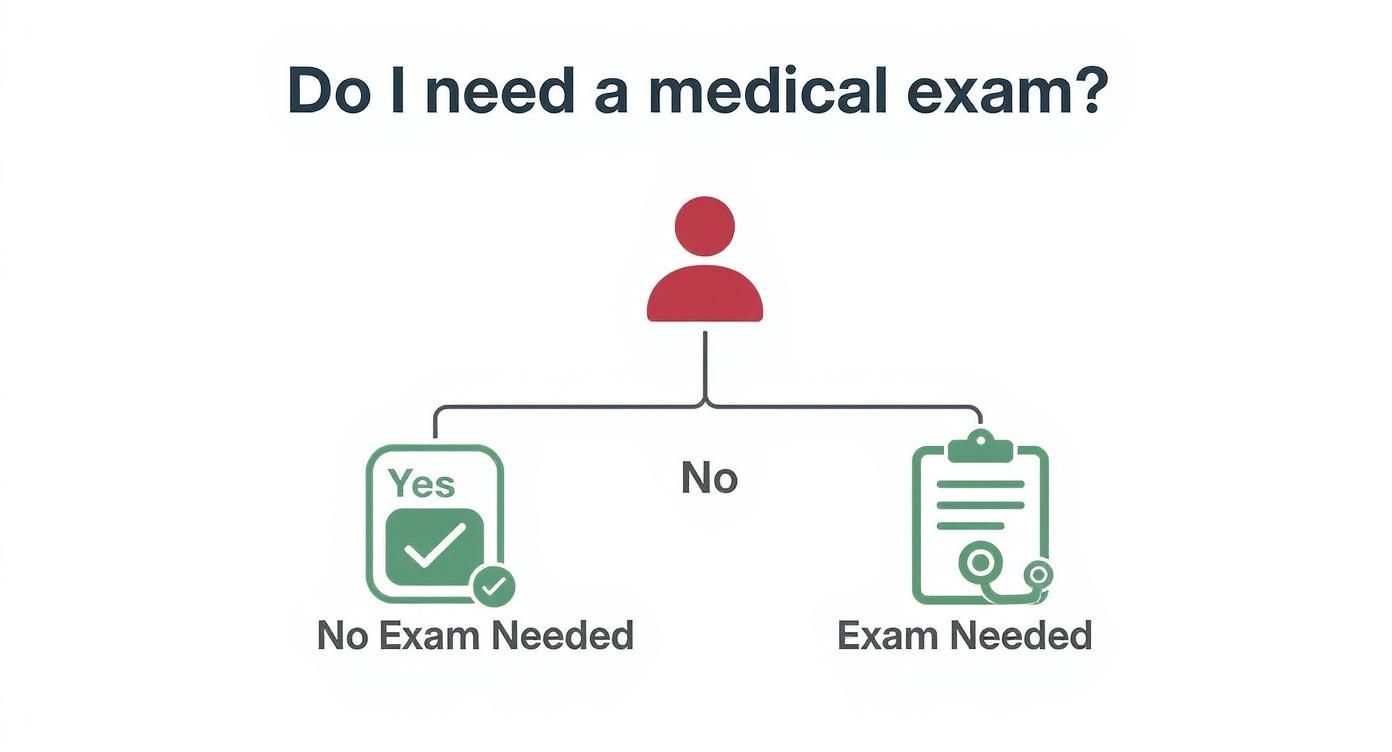
As you can see, giving straightforward, 'healthy' answers on your questionnaire is the most direct route to getting approved without needing a medical.
When an Insurer Might Need More Information
While instant decisions are common, there are plenty of times an insurer will need to dig a little deeper before offering you a policy. This isn't a "no" – it just means they need more context to accurately price your cover.
An insurer's request for more information, such as a GP report, is a standard part of the underwriting process. It allows them to offer fair terms based on a complete understanding of your health, rather than making assumptions.
This usually happens in a few key scenarios:
- Pre-existing Medical Conditions: If you have a condition like diabetes, high blood pressure, or a history of heart issues, the insurer will almost certainly want to see a report from your GP. Our guide offers more detail on ing for life insurance with medical conditions.
- High Cover Amounts: If you're ing for a large sum, say over £750,000, it typically triggers a more thorough review, which could involve a nurse screening or even a full medical exam.
- Complex Family History: A history of serious hereditary conditions (like heart disease or certain cancers) in close relatives at a young age will make an insurer want to understand the potential risk.
- Older Applicants: If you're over 50 or 55, underwriters are naturally more cautious and are more likely to ask for extra proof of your health.
Think about it this way: a 58-year-old ing for £100,000 of cover who has a history of heart problems presents a more complex risk than our 35-year-old homeowner. The insurer will definitely ask for a GP report to see how the condition is being managed before they can make a decision. To get a better handle on how insurers view these things, this guide on Travel Health Insurance Coverage for Pre-existing Conditions is quite insightful, even though it's about a different type of insurance.
Ultimately, whether you qualify for no medical exam life insurance comes down to how easily an insurer can get a clear picture of your risk from the information you provide.
Choosing the Right Type of Policy
Once you've decided that no medical exam life insurance is a good fit, the next job is picking the right type of policy. Not all life insurance is created equal, and what’s best for you will depend on your personal circumstances, your budget, and what you want to protect.
The main policies available in the UK that often skip the medical are designed for specific needs. Let's break down the most common ones: Level Term, Decreasing Term, and Over 50s plans.
Level Term Insurance
Level Term Insurance is probably the most popular and easiest to understand. You choose a set amount of cover (the payout) and a specific term (how long the policy lasts). If you pass away during that term, your loved ones receive a fixed, lump-sum payment.
The key word here is ‘level’ – both your monthly premium and the final payout amount stay exactly the same for the whole policy term. This predictability makes it a fantastic choice for families who need a consistent financial safety net.
- Who is it for? It’s ideal for parents with young children who want to ensure living costs, school fees, and other family expenses are covered. It's also a good fit for people wanting to cover large debts that don't shrink over time, like an interest-only mortgage.
- How does it work? For example, a 30-year-old could take out a £200,000 policy over a 25-year term. Whether they pass away in year one or year twenty-four, their family receives the full £200,000.
- Typical Cover Limits: Without a medical exam, you can often secure up to £750,000 of level term cover, depending on your age and health profile. Our guide to term life insurance with no medical questions provides further details.
Decreasing Term Insurance
Decreasing Term Insurance works a lot like level term, but with one crucial difference: the payout amount reduces over the life of the policy. Because the potential payout gets smaller each year, the premiums are typically lower than for a level term policy.
The most common use for decreasing term insurance is to protect a repayment mortgage. As you pay off your mortgage each month, the outstanding loan amount shrinks, and your life insurance cover is designed to shrink alongside it, ensuring the debt can always be cleared.
- Who is it for? Homeowners with a repayment mortgage are the primary users of this policy. It gives them peace of mind that their family won't have to worry about mortgage payments if the worst should happen.
- How does it work? If you have a £150,000 mortgage over 25 years, you would take out a policy that starts with a £150,000 payout. After 15 years, as your mortgage balance has reduced, the potential payout from your insurance will have decreased too.
- Typical Cover Limits: Similar to level term, cover amounts often go up to £500,000 or more without needing a medical, as long as you meet the insurer’s health and lifestyle criteria.
Acceptance Over 50s Plans
For UK residents in a specific age bracket, Acceptance Over 50s Plans offer a different path to getting covered. As the name suggests, acceptance is competitive if you meet the age criteria, which is usually between 50 and 85. There are no health questions and no medical checks whatsoever.
The payouts are typically capped around £20,000, and premiums can start from just a few pounds per month, making it a simple way to leave something behind.
- Who is it for? This policy is designed for those aged 50-85 who might have pre-existing health conditions that make other types of insurance difficult to get or too expensive. It's often used to cover funeral costs or leave a small gift for family.
- How does it work? A key feature to be aware of is the 'waiting period', which is usually the first 12 or 24 months of the policy. If you pass away from natural causes during this period, the insurer will typically just refund the premiums you've paid rather than the full cash sum. Death due to an accident, however, is usually covered from day one.
- Typical Cover Limits: Cover amounts are modest, generally ranging from £5,000 to £20,000. The final amount depends on your age and the monthly premium you choose to pay.
Pros and Cons of Skipping a Medical Exam

Choosing any kind of insurance is a balancing act, and no medical exam life insurance is no different. The convenience is a massive draw for many people, but you need to look at both sides of the coin.
This balanced view will help you work out if skipping the medical exam really fits with your life and financial goals.
The Advantages of No Medical Policies
For a lot of people in the UK, the benefits of avoiding a medical exam are compelling. They remove common hurdles that might otherwise stop someone from getting the vital cover they need to protect their family.
Here are the main upsides:
- Speed: This is probably the biggest selling point. Traditional underwriting can drag on for weeks. With a no medical approach, you can often get a decision—and be fully covered—in as little as 30 minutes.
- Convenience: You can sort the whole thing out from your sofa. No appointments to book, no taking time off work, and no needles or medical tests.
- Accessibility: These policies are a lifeline for people who are anxious about medical procedures or have a phobia of needles. It ensures these fears don't stop them from securing financial protection.
The real beauty of a no medical exam policy is its simplicity. It cuts out the most time-consuming and often inconvenient part of the process, making life insurance quicker and easier to get than ever before.
Potential Disadvantages to Consider
While the plus points are clear, it's just as important to understand the trade-offs. When an insurer is working with less information, they have to manage their risk differently, and that can impact the policy they offer you.
Think about these potential downsides:
- Potentially Higher Premiums: Because the insurer has a less detailed picture of your health, they might price the policy more cautiously. For a healthy person, the cost difference could be tiny, but for others, it might be more noticeable.
- Lower Cover Limits: Insurers usually cap the amount of cover you can get without a medical exam, often somewhere around £500,000 to £750,000. If you need a bigger sum to cover a large mortgage or protect a high income, you'll likely need to provide more medical details.
- Not Always Best for Managed Conditions: If you have a health condition that's well-managed with medication and regular check-ups, a policy with full medical underwriting could actually secure you a better rate. A report from your GP can prove your health is stable, which often leads to more favourable premiums.
Comparing No Medical vs Full Medical Underwriting
To see how these two routes differ, a side-by-side comparison can be helpful.
| Feature | No Medical Exam Process | Full Medical Underwriting Process |
|---|---|---|
| Speed | Very fast, often instant decisions. | Slower, can take several weeks. |
| Convenience | High, completed entirely online or by phone. | Lower, may require a nurse visit or GP appointment. |
| Premiums | Can be slightly higher to offset insurer risk. | Can be lower, especially for those in good health. |
| Cover Limits | Generally lower, often capped under £750,000. | Higher sums assured are available. |
| Best For | Healthy, younger applicants needing fast cover. | Those with managed health conditions or needing high cover. |
Ultimately, the best choice boils down to your priorities. If getting cover sorted quickly and easily is your main focus, no medical exam life insurance is a fantastic option. However, if your goal is to get the highest amount of cover possible or to lock in the absolute competitive premium, then the more detailed underwriting process might be the smarter move.
How to Apply and Get the Best Quotes
Getting a no medical exam life insurance policy is usually a quick process, but knowing the ropes can make it even smoother. If you get your information ready and understand what insurers are looking for, you can track down the best quotes and get your family protected in no time.
Step 1: Get Your Key Information Together
Before you dive into comparing quotes, it’s a smart move to have all the necessary information to hand. This will make filling out application forms much quicker and more accurate.
You’ll generally need:
- Personal Details: Your full name, date of birth, and current address.
- Lifestyle Information: Honest details about your smoking status, alcohol consumption, and any high-risk hobbies.
- Medical History: Information on any current or past health conditions, medications you're taking, and your GP’s details.
- Family Medical History: Insurers might ask about serious hereditary conditions that have affected close relatives (your parents or siblings).
Step 2: Compare Quotes from UK Insurers
Once you have your info, the next step is to see what’s out there. Using an online comparison service is the most efficient way to get a clear picture of the market. Rather than hopping between individual insurer websites, you can see a range of quotes in one place.
The UK life insurance market is fiercely competitive, with plenty of providers offering policies that don't require a medical for healthy applicants.
Comparing quotes is crucial because it lets you see different term life insurance rates and find a premium that fits your budget.
Step 3: Complete the Application with Total Honesty
When you fill out the application, honesty isn't just the best policy—it's the only one. It can be tempting to downplay a health issue, but this can backfire.
Under regulations set by the Financial Conduct Authority (FCA), you have a duty to provide accurate and complete information. Failing to do so, a practice known as 'non-disclosure', could give the insurer grounds to void your policy and refuse to pay a claim. This would leave your family without the financial protection you worked to put in place.
Always give your answers a final check before you hit submit. This commitment to honesty ensures your policy is valid and will pay out when your family needs it most.
Frequently Asked Questions (FAQ)
Here are some quick answers to common questions about no medical exam life insurance in the UK.
Can I still get cover if I have a pre-existing condition?
Yes, in many cases, you can. Insurers are well-versed in handling applications from people with a range of health conditions. If you have a common and well-managed condition, like high blood pressure or type 2 diabetes, you can often get cover by completing the health questionnaire. For more complex issues, the insurer might request a report from your GP.
Is it always more expensive to skip the medical?
Not necessarily. For younger, healthier people, the price you're quoted is often just as competitive as a policy that requires a full medical. Where it can get pricier is if your answers flag a higher risk, as the insurer is working with slightly less information.
What happens if I forget to mention a health issue?
You must be completely honest on your application. Forgetting or deliberately leaving out health information is called 'non-disclosure'. Under rules set by the Financial Conduct Authority (FCA), if an insurer later discovers this, they have the right to cancel your policy and refuse to pay a claim. Always double-check your answers.
How much cover can I get without a medical exam?
The amount of cover varies between insurers and depends on your age and health. Generally, you can secure a significant amount of cover without seeing a doctor. For term life insurance, policies often go up to around £500,000 to £750,000. If you need more cover, it will usually trigger a request for more medical details.
Ready to see how affordable your cover could be? At Discount Life Cover, we make it simple to compare quotes from the UK's top insurers in minutes. Get your free, no-obligation quote today and take the first step towards protecting what matters most.
This article is for information purposes only and does not constitute financial advice. Discount Life Cover is not providing personalised recommendations. Insurance policies vary depending on individual circumstances. For advice tailored to your situation, please speak with a qualified financial adviser or request a personalised quote.
Leave a Reply