
Thinking about life insurance can feel like just another task on a long to-do list, and let's be honest, the potential cost is often a major sticking point. But what if protecting your family wasn't about spending a lot, but about spending smart? Even a small, budget life insurance policy can deliver incredible peace of mind and financial security right when it's needed most.
Why Smart Life Insurance Is So Crucial Today
Nobody enjoys talking about life insurance. It's not exactly dinner party conversation. Yet, for so many families across the UK, it is arguably the most important financial safety net they can put in place. The tough reality is that without it, loved ones could face a real financial struggle, from keeping up with mortgage payments to just covering day-to-day bills.
A Common Real-World Scenario
Picture a young couple, let's call them Sarah and Tom, who have just taken the plunge and bought their first home. They have a new mortgage, car payments, and are hoping to start a family soon. Their combined income just about covers everything, but there is not much left for savings.
If the unthinkable were to happen and one of them passed away, the surviving partner would suddenly be faced with the entire mortgage and all household bills on a single salary. It's a hugely stressful situation that could easily force them to sell their dream home during an already heartbreaking time.
This story really gets to the heart of what life insurance is for: it provides a tax-free lump sum to your loved ones, making sure they can cope financially without you. Even a modest policy can be enough to clear the mortgage, wipe out other debts, and create a buffer for the future.
Understanding the UK's "Protection Gap"
This isn't just an individual worry; it's a nationwide issue. It is staggering to think that over a quarter of British adults have no life insurance at all, creating what experts call the "Protection Gap". This gap is the shortfall between the financial support families would actually need and the cover they have in place.
Recent research has shown this could leave a colossal lifetime financial burden of around £4.2 million for every 100 families affected. It paints a stark picture of lost homes and financial ruin across the country.
The bottom line is that many households are just one tragic event away from a full-blown financial crisis. Smart, affordable life insurance is the bridge that closes this gap, ensuring a personal tragedy does not also become a financial catastrophe.
By understanding these very real risks and exploring the many benefits of having life insurance, you can start to see it not as just another expense, but as a core part of responsible financial planning. It’s about giving yourself the power to protect what matters most, without having to break the bank to do it.
Getting to Grips with Your Affordable Life Insurance Options
To find a policy that genuinely fits your budget, you first need to understand what you are actually buying. Life insurance isn't a one-size-fits-all product, and picking the right type is the first massive step towards landing an affordable premium. Let's break down the main players in the UK market, without the confusing jargon.
This image gives a great visual overview of the different policies a financial adviser would typically run through with a family.
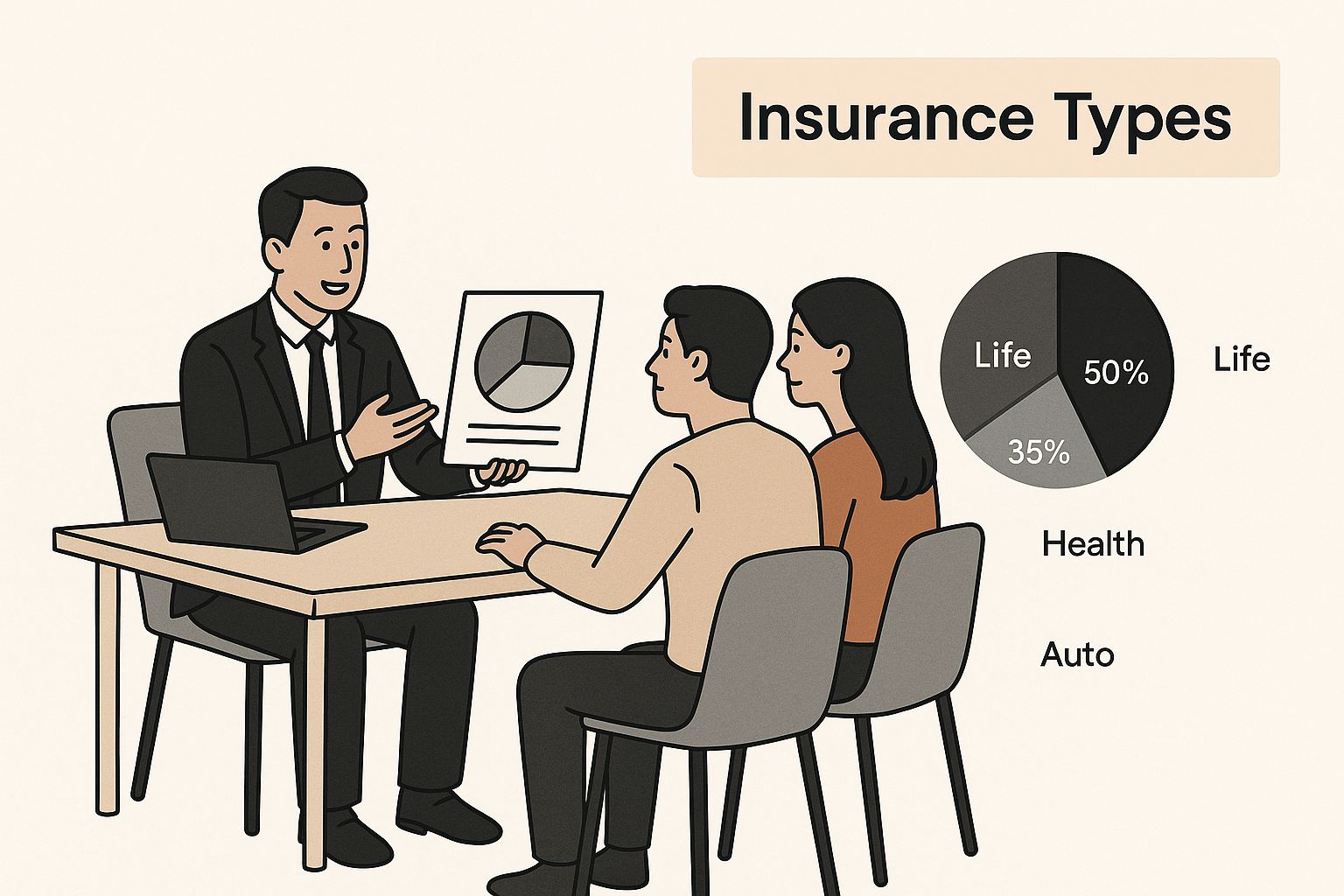
As you can see, for most people watching the pennies, the core decision boils down to term life insurance. This is simply cover that lasts for a set number of years.
Level Term vs Decreasing Term Insurance
The two most common and budget-friendly policies you'll come across are Level Term and Decreasing Term insurance. They might sound similar, but they're built for very different jobs, and choosing the right one is absolutely crucial for your wallet.
Here’s a quick table to show you how they stack up against each other.
Level Term vs Decreasing Term Life Insurance
| Feature | Level Term Insurance | Decreasing Term Insurance |
|---|---|---|
| Payout Amount | Stays the same throughout the policy term. | Reduces over the policy term. |
| Primary Use | Leaving a fixed lump sum for family living costs, rent, or an interest-only mortgage. | Paying off a repayment mortgage or other large loan that decreases over time. |
| Cost | More expensive than decreasing term. | Typically the cheapest form of life insurance. |
| Best For | Families wanting a competitive safety net for ongoing expenses. | Homeowners who just want to ensure their mortgage is cleared. |
So, what does this mean in practice?
With Level Term Insurance, the payout amount (what the industry calls the 'sum assured') is fixed for the entire policy length. If you take out a £200,000 policy for 25 years, your family gets £200,000 whether you pass away in year one or year 24. This makes it perfect for covering things that don't shrink over time, like providing for your children's futures or giving your partner a lump sum to maintain their lifestyle.
On the other hand, with Decreasing Term Insurance, the payout amount gradually drops over the policy's term. This is almost always designed to track alongside a repayment mortgage. As you pay off your mortgage, you need less life cover to clear the outstanding debt. Because the insurer's risk gets smaller every year, these policies are usually the most affordable type of life insurance you can buy.
Another Clever Cost-Effective Option: Family Income Benefit
For those on a really tight budget, there's another smart alternative called Family Income Benefit. Instead of paying out one huge lump sum, this policy provides a regular, tax-free income to your loved ones for the rest of the policy's term.
For example, you could set up a policy to pay out £1,500 every month until your youngest child turns 21. For the person receiving it, this can feel far more manageable than a giant lump sum. It's often than a traditional policy because the total potential payout decreases over time. It is a really practical way to replace a lost salary without the hefty premium.
You can find out more about the best life insurance UK policies in our more detailed guide.
Understanding these key differences is what gives you the power to pick a policy that provides the right protection without making you pay for cover you do not actually need. That's the real foundation of finding genuine budget life insurance that works for you.
What Really Drives Your Life Insurance Cost?
Ever wondered what goes on behind the scenes when an insurer calculates your price? It's not just a number plucked from thin air. Life insurance premiums are the end result of a detailed risk assessment, and understanding the moving parts gives you the power to find genuine budget life insurance by knowing which dials you can actually adjust.

At its core, an insurer is trying to predict the likelihood of you passing away during the policy's term. The higher they perceive that risk to be, the higher your monthly premium will be. Simple as that.
Your Age and Health
These two are the real heavyweights of life insurance pricing. For insurers, it is a straightforward equation: the younger and healthier you are, the lower the risk, and the your cover will be. It is why ing for a policy in your 20s or 30s can lock in some incredibly low rates for decades to come.
Your medical history, of course, plays a massive part in this. Insurers will want to know about:
- Existing conditions: Things like diabetes, heart conditions, or high blood pressure.
- Family medical history: Particularly hereditary conditions such as cancer or heart disease.
- Your height and weight: They use this to calculate your Body Mass Index (BMI).
Conditions like Metabolic Syndrome can significantly influence your health profile. This really highlights how lifestyle changes can make a huge difference not just to your long-term health, but to your insurance costs too. If you're interested in learning more, there's a great resource for understanding Metabolic Syndrome and its impact on health and the positive steps you can take.
Your Lifestyle Choices
Your day-to-day habits also get put under the microscope. Unsurprisingly, the biggest lifestyle factor by a country mile is smoking.
Insurers view smoking (and often vaping) as a major health risk. A smoker can expect to pay at least double the premium of a non-smoker for the exact same policy. If you quit, you can ask your insurer to review your premiums after 12 months, potentially cutting your costs in half.
Other things they will look at include your alcohol consumption and whether you have a particularly high-risk job or take part in hazardous hobbies like rock climbing or motorsports. Whatever the question, honesty is always the best policy on your application form, as failing to disclose information could invalidate a future claim.
The Policy Details You Choose
Beyond your personal circumstances, the specifics of the policy you build have a direct and immediate impact on the price you'll pay.
- The Cover Amount: This is the lump sum your family would receive. A £100,000 policy will naturally cost a lot less than a £300,000 one.
- The Policy Length: A 30-year term carries more risk for the insurer than a 15-year term, so the premium will be higher.
- The Policy Type: As we touched on earlier, decreasing term cover is almost always than level term cover.
So, what does this all mean in pounds and pence? Data shows that the average cost of a policy in the UK was £32.64 per month in 2024 for a payout of around £160,871, but this varies hugely from person to person. Don't let that number scare you; plenty of affordable options are out there, with some policies starting from as little as 20p a day.
By carefully considering these elements, you can find the right balance for your needs and budget. A good place to start is by calculating how much life insurance you might need in our dedicated guide.
Proven Tactics to Lower Your Insurance Premiums
Knowing what drives your premium is one thing, but actively taking steps to lower it is how you land a truly affordable policy. This is where you can take control, making smart, practical choices that can shave pounds off your monthly payments without sacrificing the quality of your cover.
Consider Joint vs Single Policies Carefully
For couples, the immediate thought is often a joint life insurance policy. It covers two people but only pays out once—usually on the first death—after which the policy simply ends. While this can seem simpler and slightly upfront, it is rarely the best value or the most flexible option.
In most cases, two separate single policies provide far better long-term protection.
- Double the Payout: If the worst happened and both partners were to pass away during the term (in a car accident, for example), two single policies would mean two separate payouts. A joint policy only ever pays out once.
- Flexibility After a Split: If the relationship ends, single policies carry on independently without any fuss. Trying to split a joint policy is far more complicated and often impossible, forcing at least one partner to find new cover when they are older and likely facing higher premiums.
Two single policies might cost a fraction more each month, but the superior cover and flexibility often make it the smarter financial choice for modern families. Always get quotes for both to see the actual price difference for your situation.
Use a Broker to Compare the Market
Going directly to one insurer is like only visiting one shop on the high street—you will never know if you are getting a good deal. Every insurer, from major brands like Aviva and Legal & General to specialists, has its own underwriting rulebook. This means they all view risk differently, and one might penalise a certain health condition while another is far more lenient.
This is where an independent broker like Discount Life Cover, regulated by the Financial Conduct Authority (FCA), is indispensable. A broker compares quotes from a wide range of top UK insurers all in one go.
This process doesn't just save you time; it saves you a significant amount of money. A broker's entire job is to find the insurer that views your specific circumstances most favourably. It’s the single most effective way to ensure you aren't overpaying for the cover you need.
Put Your Policy in Trust
This is one of the simplest and most powerful financial planning tips available, yet so few people actually do it. Placing your life insurance policy 'in trust' is a straightforward legal arrangement that can have a massive impact on the payout your loved ones receive.
Best of all, it costs absolutely nothing to set up.
When a policy is written in trust, the payout is legally separate from your estate. This delivers two huge benefits:
- Avoids Inheritance Tax: The money goes directly to your beneficiaries without being counted as part of your estate. This means it will not be subject to a potential 40% inheritance tax bill.
- Faster Payout: The money also bypasses the often painfully slow probate process. Your family can get access to the funds within weeks, rather than waiting months—or even longer—for the estate to be settled.
Your broker can help you with the simple paperwork when you first take out the policy. It is a no-cost step that ensures the full amount of your cover gets to your family quickly and efficiently, right when they need it most.
Are Optional Policy Add-Ons Worth the Money?
When you’re focused on finding a lean, budget life insurance policy, it's easy to see the optional extras insurers offer as a simple upsell. Things like Critical Illness Cover or a Waiver of Premium promise more protection, but do you really need them when every pound counts?
Honestly, it all comes down to your personal financial safety net.

These additions are not just thrown in to bump up the price; they are designed to plug very specific holes in your financial plan. Before you dismiss them out of hand, it is worth taking a good look at the protection you already have.
When Add-Ons Are a Financial Lifeline
For some people, these extras aren't a 'nice-to-have'—they are an absolute necessity.
For the Self-Employed: If you work for yourself, there is no sick pay to catch you. A serious illness could halt your income overnight. This is where adding Critical Illness Cover to your life policy can be a complete game-changer. It provides a tax-free lump sum if you are diagnosed with a specified condition, giving you the cash to cover your bills while you recover. It protects your business and your family.
For Those with Limited Savings: The Waiver of Premium benefit is another powerful tool. If you cannot work because of illness or injury (usually for six months or longer), the insurer steps in and pays your life insurance premiums for you. It's a simple feature that ensures your vital cover stays active when you have no income, meaning you will never have to choose between your health and your family's protection.
When You Might Not Need Them
On the other hand, you might already have solid cover from other sources, making these add-ons an unnecessary cost.
Take a close look at your employment benefits. If you have a generous sick pay package that covers you for six to twelve months, the immediate need for critical illness or income protection cover is significantly reduced. You may decide your money is better spent on a larger core life insurance payout instead.
Bundling policies is becoming more common because it often offers simplicity and savings. In fact, the move towards bundled policies grew by 13.5% in 2023, which shows a real desire from people for comprehensive, cost-effective protection. It's clear that UK households are getting more clued up about strengthening their financial safety nets in uncertain times. To see more trends, you can read more about UK insurance industry statistics.
Ultimately, the decision boils down to one simple question: what happens to your finances if you get seriously ill? If you have solid workplace benefits and a healthy savings pot, you might be fine skipping the extras. If not, they could be worth every single penny.
For more tailored guidance on this, you can learn more about critical illness cover from our experts. By making an informed choice, you ensure your policy is both affordable and perfectly suited to what you actually need.
Frequently Asked Questions about Budget Life Insurance
Can I get life insurance if I am over 50?
Yes, absolutely. There are specific ‘Over 50s’ life insurance policies designed for this. These policies guarantee acceptance with no medical questions, but they typically offer smaller, fixed payouts intended to cover funeral costs or leave a small gift. For larger cover amounts, standard term life insurance is still available, though premiums will be higher than for a younger applicant.
What happens if I stop paying my premiums?
If you stop paying your monthly premiums, your life insurance policy will 'lapse', meaning your cover will end. You will not get any money back for the premiums you have already paid. If you are struggling financially, contact your insurer or broker immediately. They may be able to offer solutions, such as reducing your cover amount to lower your premiums, rather than letting the policy end completely.
Can I get affordable life insurance with a pre-existing medical condition?
Yes, in most cases you can. Having a condition like diabetes, high blood pressure, or a history of mental health issues does not automatically disqualify you. You must be completely honest on your application. Insurers will assess your specific situation. Some insurers specialise in or are more lenient towards certain conditions, which is why using a broker is crucial to find the best provider for your circumstances.
Ready to find a policy that fits your budget and protects what matters most? At Discount Life Cover, we compare quotes from top UK insurers to find you the best deal.
Get Your Free, No-Obligation Quote Today
This article is for information purposes only and does not constitute financial advice. Discount Life Cover is not providing personalised recommendations. Insurance policies vary depending on individual circumstances. For advice tailored to your situation, please speak with a qualified financial adviser or request a personalised quote.
Leave a Reply