
Let's start with a simple but slightly scary question: if your salary vanished tomorrow, how long could you cope? It's a thought most of us would rather avoid, but income protection insurance is designed to be your financial co-pilot, ready to take the controls if illness or injury grounds you from work.
What Is Income Protection Insurance and Why Do You Need It?

Think of your monthly income as the fuel that keeps your entire life running. It pays the mortgage, keeps the lights on, fills the fridge, and funds your future. If that fuel line gets cut because you're too sick or injured to work, everything can grind to a halt, and fast.
Income protection insurance is a policy designed for exactly this scenario. It pays you a regular, tax-free monthly income—usually somewhere between 50% and 70% of your typical earnings—if you can't work due to an accident or illness. This support keeps coming in until you're back on your feet, your policy ends, or you reach retirement age.
The Problem With Relying on Sick Pay
Many people assume their employer's sick pay or a bit of government help will see them through. Unfortunately, that's often a dangerous assumption. While some companies have fantastic sick pay policies, many others only offer the bare legal minimum.
Statutory Sick Pay (SSP) in the UK currently stands at just £116.75 per week, for a maximum of 28 weeks. For most families, that's nowhere near enough to cover the essentials, leaving a huge gap in the budget.
Relying on your savings or SSP alone is a massive gamble. An emergency fund is brilliant for short-term hiccups, but it was never designed to cover a prolonged period off work that could stretch into months, or even years.
Who Needs Income Protection The Most?
While anyone who relies on their paycheque can benefit, this cover becomes absolutely critical for certain people. If you fall into one of these groups, the financial risk of not having a backup plan is significantly higher.
- Homeowners with Mortgages: Your mortgage is almost certainly your biggest monthly outgoing. Income protection helps you keep up with payments and stay in your home.
- Parents and Guardians: When you have children or other dependents relying on you, their stability is paramount. This cover ensures their needs are met, no matter what.
- The Self-Employed: With no employer sick pay to fall back on, the self-employed are completely exposed. One serious illness can wipe out their income stream overnight.
Ultimately, protecting your income is about protecting your lifestyle, your family, and your future. It's the peace of mind that comes from knowing a health crisis won't automatically trigger a financial one. A great first step is setting clear financial goals to understand what you're protecting. For a deeper dive, our comprehensive guide to income protection cover has all the details you need.
Decoding the Language of Your Policy
To find the best income protection insurance the UK has to offer, you first need to get your head around the language insurers use. Policy documents can look a bit intimidating, full of jargon that isn't part of your everyday vocabulary. But once you get a handle on a few key terms, you'll be able to compare policies like a pro.
Let's break down the essential terms you'll definitely come across.
The Deferred Period: Your Waiting Time
The deferred period (sometimes called the 'waiting period') is simply the length of time you need to be signed off work before the insurer starts paying out your monthly benefit. This is one of the biggest decisions you'll make, as it has a major impact on how much you pay for your cover.
Insurers in the UK typically offer these common deferred periods:
- 4 weeks: This gets you financial support much faster but naturally comes with a higher monthly premium. It's a popular choice for people with limited savings or those whose employer offers little to no sick pay.
- 13 weeks: A very common middle-ground option. This period often lines up perfectly with many standard company sick pay schemes, striking a great balance between cost and how quickly the payments start.
- 26 weeks: Opting for a longer wait like this can bring your monthly premium down quite a bit. It’s a smart move if you have a decent savings pot or your employer has a generous sick pay policy.
- 52 weeks: This will get you the cheapest premiums, but it means you need to have enough money set aside to cover your expenses for a full year before the policy kicks in.
When you're picking your deferred period, the goal is to make it dovetail with your existing safety nets. Dig out your employment contract and see exactly how long your company will pay you if you're ill, then take a hard look at your savings. Your insurance should start paying out just as your other support runs dry.
Level of Cover: How Much You'll Receive
The level of cover is the monthly, tax-free sum your policy will pay you. In the UK, insurers regulated by the Financial Conduct Authority (FCA) will typically let you protect somewhere between 50% and 70% of your gross (pre-tax) salary.
This cap exists to ensure there is always a financial incentive to return to work. When deciding how much cover you need, add up all your essential monthly costs—your mortgage or rent, bills, food, travel—to make sure the payout is enough to keep your head above water.
Understanding Your Premiums
Your premium is what you pay each month for your cover. This price isn't just a random number; it's calculated carefully based on risk. Crucially, your premiums can be structured in one of three ways over the life of the policy.
- Premiums: These premiums are fixed for the entire life of your policy. They might look a bit more expensive from day one, but you get total peace of mind knowing the cost will never go up. For long-term budgeting, this is usually the best bet.
- Reviewable Premiums: With this setup, the insurer reserves the right to review your premiums at certain points (e.g., every five years). They could increase the cost based on their overall claims experience. These often start but you lose that long-term cost certainty.
- Age-Banded Premiums: These are designed specifically to increase each year as you get older. They start off very cheap but rise predictably based on a schedule you agree to at the start. This can work well for people who expect their income to increase over the years, allowing them to absorb the rising costs.
To truly get to grips with your income protection policy, it helps to understand the wider context of insurance decisions, including general insurance company coverage considerations. Knowing these terms puts you in the driver's seat, empowering you to properly compare quotes from big names like Aviva, LV=, and Legal & General, and making sure you find the best value and the right protection for you.
Comparing Different Types of Income Protection Cover
When you start shopping around for income protection, it's tempting to focus on two things: the monthly premium and the potential payout. But the single most important detail is often buried deep in the policy's small print: the definition of what it actually means to be ‘unable to work’.
This little clause is the gatekeeper to a successful claim. Not all policies are created equal, and insurers use three main definitions of incapacity. Understanding the difference between them is the most important step you can take.
Own Occupation: The Gold Standard
There’s a reason financial advisers almost always recommend ‘Own Occupation’ cover. Simply put, it's the most comprehensive and claimant-friendly definition you can get. An Own Occupation policy pays out if an illness or injury stops you from doing the specific tasks of your own job. It doesn’t matter if you could technically do something else. If you can’t do your job, the policy pays out.
- Example: Imagine a surgeon who develops a slight tremor in their hands. They can no longer perform delicate surgery, but they're perfectly capable of working as a medical consultant. With Own Occupation cover, they’d receive their full benefit because they can no longer work as a surgeon.
Suited Occupation: The Middle Ground
A step down from the gold standard is ‘Suited Occupation’ cover. This definition is a bit fuzzier and offers less certainty. Under this clause, an insurer will only pay out if your illness or injury prevents you from doing your own job and any other job you're reasonably suited for, based on your experience and training.
- Example: Let's go back to our surgeon. With a Suited Occupation policy, the insurer could argue that because the surgeon has the skills to be a medical lecturer, they aren't completely unable to work. This could easily lead to a rejected claim.
Any Occupation: The Riskiest Choice
Finally, we have the cheapest and most restrictive definition: ‘Any Occupation’. Policies with this definition are usually best avoided. An Any Occupation policy will only pay out if you are so unwell or injured that you cannot perform any work at all.
- Example: A self-employed electrician suffers a serious back injury and can no longer perform the physical demands of their trade. With an 'Any Occupation' definition, their insurer could refuse the claim by arguing they could still work in a call centre. This makes it incredibly difficult to ever make a successful claim.
Own vs Suited vs Any Occupation Cover Compared
| Definition Type | Claim Trigger | Best For | Example Scenario |
|---|---|---|---|
| Own Occupation | You can't perform the main duties of your specific job. | Professionals in skilled or specialised roles (e.g., surgeons, pilots, solicitors, skilled trades). | A dentist with a hand injury can no longer treat patients but could do admin work. The policy pays out. |
| Suited Occupation | You can't do your job or any job you're suited for by experience/training. | Those in less specialised roles where skills are highly transferable across different jobs. | An office manager with chronic fatigue can't handle their high-pressure role but could do basic data entry. A claim might be rejected. |
| Any Occupation | You are so incapacitated that you cannot perform any job whatsoever. | Generally not recommended; a last resort if other cover is unavailable or unaffordable. | An HGV driver loses their sight. They can't drive but could work from home on the phone. A claim would likely be denied. |
As you can see, 'Own Occupation' cover offers the greatest peace of mind, ensuring your policy is there for you if you can no longer do the job you’ve built your career on.
Short-Term vs Long-Term Cover
Another key point of comparison is how long the policy will pay out for once you make a claim.
- Short-Term Policies: These are the option. They will pay your monthly benefit for a fixed period, typically for 1, 2, or 5 years per claim. They're a decent safety net for temporary setbacks.
- Long-Term Policies: This is the most robust type of cover. It will keep paying your monthly benefit right up until you can return to work, you retire, or the policy term ends—whichever happens first. This protects you from those life-changing, career-ending conditions.
It’s crucial to remember that income protection is for illness and injury—it doesn’t cover you if you’re made redundant. Separate policies exist for that, and you can learn more about income protection for redundancy to see how that type of cover works.
The infographic below shows how different choices you make, like your deferred period and premium type, will affect the final cost of your policy.
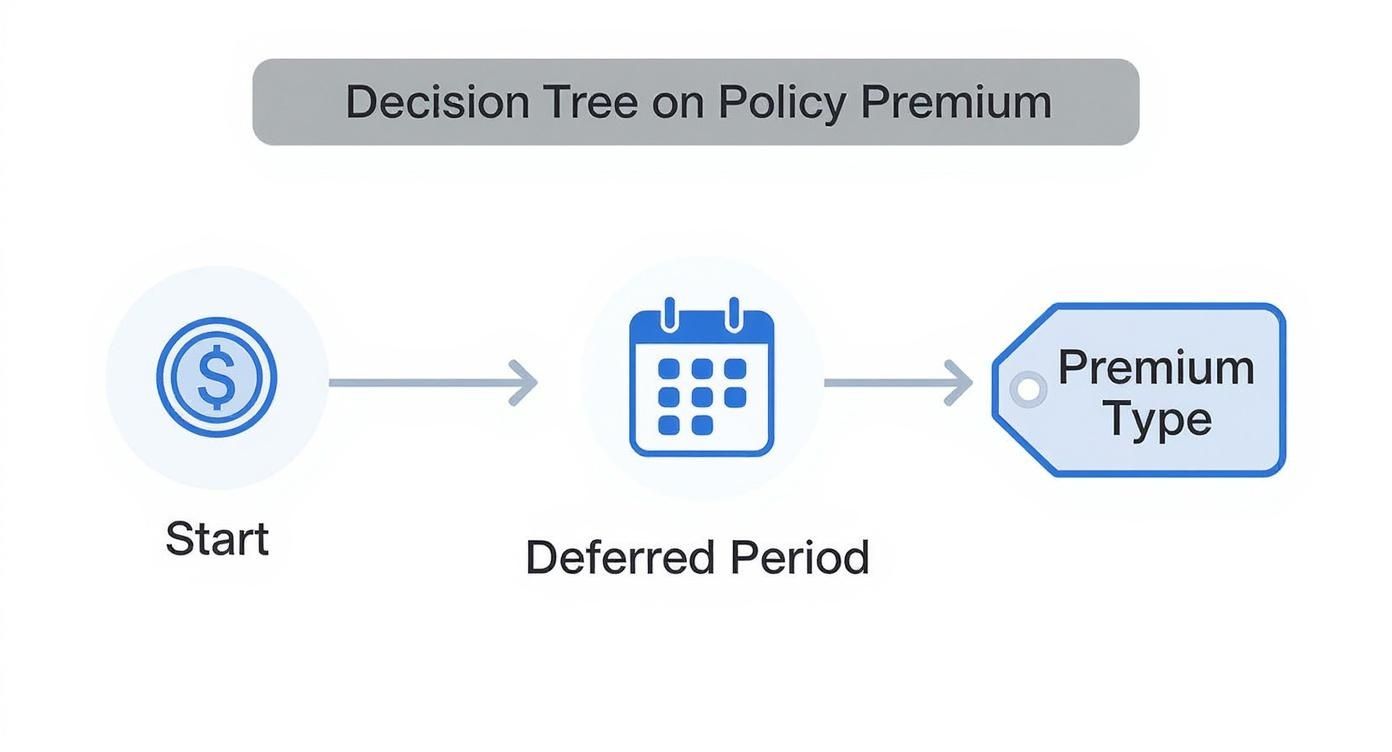
This decision tree highlights how simple tweaks, such as extending your deferred period, can make comprehensive cover much more affordable.
How Much Does Income Protection Insurance Cost?
Many people assume income protection is a luxury they can't afford, but this is one of the biggest myths out there. The truth is, it’s often much more affordable than you might imagine.
Your monthly premium is calculated specifically for you, based on your circumstances and the choices you make when setting up your policy. The insurer simply weighs up the risk.
Key Factors That Influence Your Premium
Insurers in the UK look at a handful of core elements when they work out your quote. Understanding these will show you exactly how you can find some savings.
- Your Age: The younger and healthier you are when you take out a policy, the your premiums will be.
- Your Health and Lifestyle: Insurers will ask about your medical history and whether you smoke. Being a non-smoker can lead to significant discounts.
- Your Occupation: Your job plays a massive part. An office administrator is seen as low-risk and will pay far less than a roofer, whose job comes with a higher chance of injury.
- Your Chosen Cover Amount: The bigger the monthly payout you want, the higher your premium will be.
- The Deferred Period: Opting for a longer waiting period (say, 26 or 52 weeks) can slash your monthly costs compared to a short 4-week wait.
People tend to wildly overestimate how much income protection costs. A recent survey found that the average person thinks cover for a healthy 35-year-old would set them back £58.43 a month. The reality? Actual quotes can be as low as £26.87. That's an overestimation of around 63%!
Real-World Cost Example
Let's bring this to life. Imagine a 35-year-old, non-smoking office worker who earns £40,000 a year. They want to protect 60% of their income, which works out at £2,000 per month, and they want the cover to last until they turn 67.
Here’s how tweaking just the deferred period could change their monthly premium:
- With a 4-week deferred period: The premium might be around £36 per month.
- With a 13-week deferred period: This could drop to approximately £27 per month.
- With a 52-week deferred period: The premium could be as low as £18 per month.
By aligning your waiting period with your sick pay from work or your savings, you can make some of the best income protection insurance UK policies surprisingly affordable.
How to Choose the Right Income Protection Policy
Picking the right income protection policy can feel like a massive decision. If you break it down into a few logical steps, the process becomes much clearer.
Step 1: Figure Out Your Essential Outgoings
Before you do anything else, you need a clear picture of what you're protecting. Grab a notepad and jot down every essential monthly expense:
- Housing Costs: Your mortgage payment or rent.
- Household Bills: Council tax, gas, electricity, water, and broadband.
- Food and Groceries: Your average monthly food shop.
- Transport: Car payments, fuel, insurance, and public transport tickets.
- Debt Repayments: Any loans, credit card minimums, or finance deals.
- Childcare Costs: A non-negotiable expense for many families.
Add it all up. That final number is your target. It's the minimum tax-free income you’d need each month to keep your head above water.
Step 2: Check Your Existing Safety Nets
Next, see what support you already have. This is crucial for deciding on your ‘deferred period’. First, dig out your employment contract and find your company’s sick pay policy. Do they offer full pay, and for how long? Then, take a hard look at your savings. How many months of essential outgoings could your emergency fund realistically cover?
Step 3: Be Completely Honest on Your Application
This is, without a doubt, the most important step of all. When you for income protection, you must be totally upfront about your health, lifestyle, and medical history. This is called full disclosure.
It might be tempting to omit a minor health issue to get a quote, but this is a false economy. Insurers call this ‘non-disclosure’, and it is the single biggest reason claims get rejected. According to the Association of British Insurers (ABI), a massive 91.8% of new income protection claims were paid. The main reason for rejections was people not being truthful on their application forms.
Step 4: Compare Quotes and Get Advice
Finally, never just accept the first quote you get. The UK insurance market is very competitive. Big names like Aviva, LV=, and Zurich all offer slightly different products at different prices. The easiest way to get a feel for the market is to use a comparison service. For a decision this important, getting independent advice can be invaluable. A qualified adviser can help you cut through the jargon and find the best policy for your specific situation.
FAQ: Your Top Income Protection Questions Answered
Are income protection payouts taxed?
No. Any monthly benefit you receive from a personal policy is completely tax-free. You pay your monthly premiums using your after-tax salary, so when the time comes to make a claim, the full amount you agreed on lands in your bank account.
Can I get cover if I'm self-employed?
Yes, and you'd be wise to. Income protection is arguably more vital for a self-employed person than for an employee. When you're your own boss, there's no sick pay safety net. If you can't work, your income simply stops. An income protection policy is the single most effective way to build that financial buffer.
What's the difference between income protection and critical illness cover?
They are two very different products.
- Income Protection pays a regular monthly income if any illness or injury stops you from working. It's designed to replace your salary for as long as you need it.
- Critical Illness Cover pays a single, tax-free lump sum if you're diagnosed with a specific, serious condition listed in your policy (like certain cancers, a heart attack, or a stroke).
Many people have both, using the critical illness lump sum to clear a mortgage and the income protection payments to cover day-to-day bills.
What if I have a pre-existing medical condition?
You can still get income protection, but the insurer may add specific terms to your policy. They might place an 'exclusion' on your condition, meaning you can't claim for being unable to work due to that specific illness. In other cases, they may charge a higher premium. It is vital to disclose all medical conditions during your application.
Ready to Secure Your Income?
We’ve covered a lot of ground in this guide. You now have a solid foundation to find the best income protection insurance UK providers offer for your specific needs. Protecting your salary is one of the most important financial moves you can make. It’s the safety net that stops an unexpected illness from turning into a full-blown financial crisis.
Turning Knowledge into Action
- Do the Maths: Jot down your essential monthly outgoings to figure out how much cover you need.
- Check What You've Got: Dig out your employment contract to check your company’s sick pay policy and review your savings. This will help you decide on a realistic deferred period.
- Shop Around: Comparing different insurers is the only way to find the best value and the features that truly work for you.
A bit of time spent comparing personalised quotes now can save you months, or even years, of financial worry down the line. That's what real peace of mind looks like.
By taking these simple, proactive steps, you can find a policy that gives you genuine protection. It frees you up to focus on what’s most important – getting better – without the added stress of worrying about the bills. Why not start today? Get a personalised quote and find the right cover to look after your financial wellbeing for years to come.
At Discount Life Cover, we make it simple to compare quotes from the UK's top insurers, helping you find the right protection at the right price.
Get your free, no-obligation quote today at https://discountlifecover.co.uk.
This article is for information purposes only and does not constitute financial advice. Discount Life Cover is not providing personalised recommendations. Insurance policies vary depending on individual circumstances. For advice tailored to your situation, please speak with a qualified financial adviser or request a personalised quote.
Leave a Reply